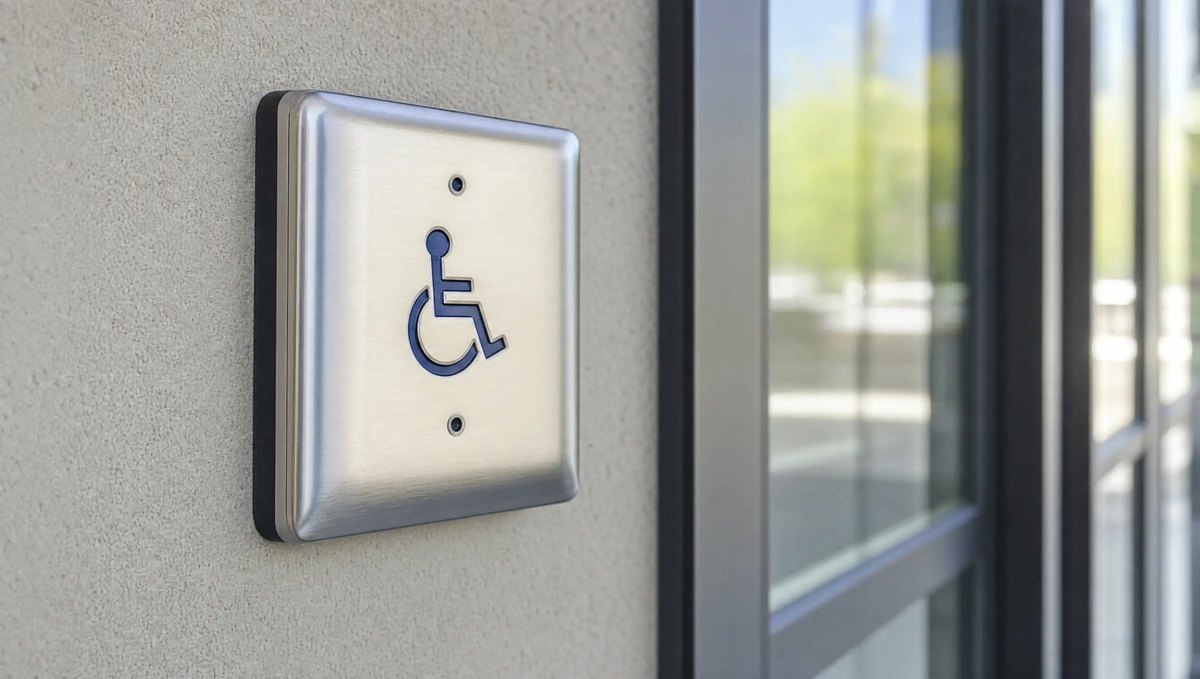
Adding an automatic entrance to a building that's already finished usually means one dreaded question: where does the wire go? Running conduit from a wall-mounted push plate to a header-mounted operator can mean trenching a slab, fishing wire through a ceiling full of ductwork, or core drilling through a wall someone just painted. A wireless door actuator setup skips most of that. The transmitter in the push plate talks to a receiver at the header over radio signal, so there's no physical path to cut open between the two.
Where Wireless Saves Real Demolition
The biggest win shows up in retrofit and tenant-finish work around Little Rock, Conway, and North Little Rock — buildings where the floor is already poured, the walls are already finished, and the owner doesn't want a construction crew back in for a month. Wireless transmitters are a strong fit when:
- The push plate sits on the opposite side of an aisle, lobby, or vestibule from the operator, with a finished floor in between.
- The wall between the plate and the header is load-bearing, tiled, or otherwise expensive to open up.
- A healthcare, retail, or hospitality space needs to stay open during the install, and cutting slab or drywall isn't an option on the timeline.
- A door is being added to an existing accessible entrance and the client wants to avoid re-trenching a walkway that was just repaved.
In these situations, a wireless actuator can turn a multi-day demolition-and-patch job into a same-day install. That said, wireless isn't a universal replacement for wired push plates — it's a tool CSC reaches for when the building layout makes trenching genuinely costly or disruptive.
Battery Life and What a Dying Battery Looks Like
Wireless push plates and transmitters run on batteries, which is the tradeoff for skipping the wire run. Battery life varies with usage volume and the specific hardware, so we won't put a number on it here — a plate in a busy hospital entrance drains faster than one on a low-traffic side door. What matters more is recognizing the warning signs before the door stops responding altogether:
- The door starts requiring two or three presses before it opens.
- Response feels delayed — a noticeable pause between pressing the plate and the door moving.
- The door only opens when someone presses the plate at a certain angle or spot.
- It works intermittently through the day, then stops responding entirely.
Any of these symptoms point to a battery on its way out, not necessarily a failed operator. Swapping the battery is a simple maintenance item, but confirming the actual cause — versus a receiver, transmitter, or operator issue — and adjusting any door settings afterward is work for a certified AAADM technician with the right diagnostic equipment.
Receiver Pairing
Every wireless push plate has to be paired to its receiver so the operator only responds to the correct transmitter and ignores signals meant for other doors nearby. This pairing is done once at install and shouldn't need to be repeated unless a component is replaced. If a plate stops working after a battery swap, or a receiver gets replaced during service, re-pairing may be needed — that's a task for the technician servicing the door, since it involves confirming the operator's response settings are still correct for that entrance afterward.
The Limits in Steel-Heavy Buildings
Wireless signals don't travel the same in every structure. Metal studs, steel decking, rebar-heavy concrete, and large HVAC equipment near the header can all weaken or block the signal between plate and receiver. In warehouses, manufacturing facilities, and buildings with heavy steel framing — common in parts of Benton, Bryant, and industrial corridors around Jacksonville and Cabot — a wireless actuator may need a receiver placed closer than usual, or in some cases a wired connection is simply more reliable. This is a site-specific call, and it's one worth making before installation rather than after a plate turns out to be unreliable.
Talk to CSC Before You Trench
If you're planning an automatic entrance in a finished building and dread the idea of opening up floors or walls, it's worth a conversation before committing to either approach. CSC Automatic Doors has served central Arkansas businesses since 1976 and can walk your site to tell you honestly whether wireless will hold up in your building. Call 501-548-2374 to talk through your entrance.
Frequently asked questions
Can a wireless push plate replace a wired one on any door?
Not always. Wireless works well when trenching or wall demolition would be costly, but heavy steel framing, thick concrete, or long distances between plate and receiver can weaken the signal. A technician can assess your specific building before you decide.
How do I know if a wireless push plate needs a new battery versus a service call?
Slow response, needing multiple presses, or intermittent operation usually point to a low battery. If a fresh battery doesn't fix it, the issue is likely with the receiver, transmitter, or operator, and it's time to call a certified technician.
Does adding a wireless transmitter change how the door's force or timing works?
No — the transmitter only sends the open signal. Any adjustment to how the door moves, closes, or holds open is a safety-critical setting that should only be handled by a certified AAADM technician with proper testing equipment.