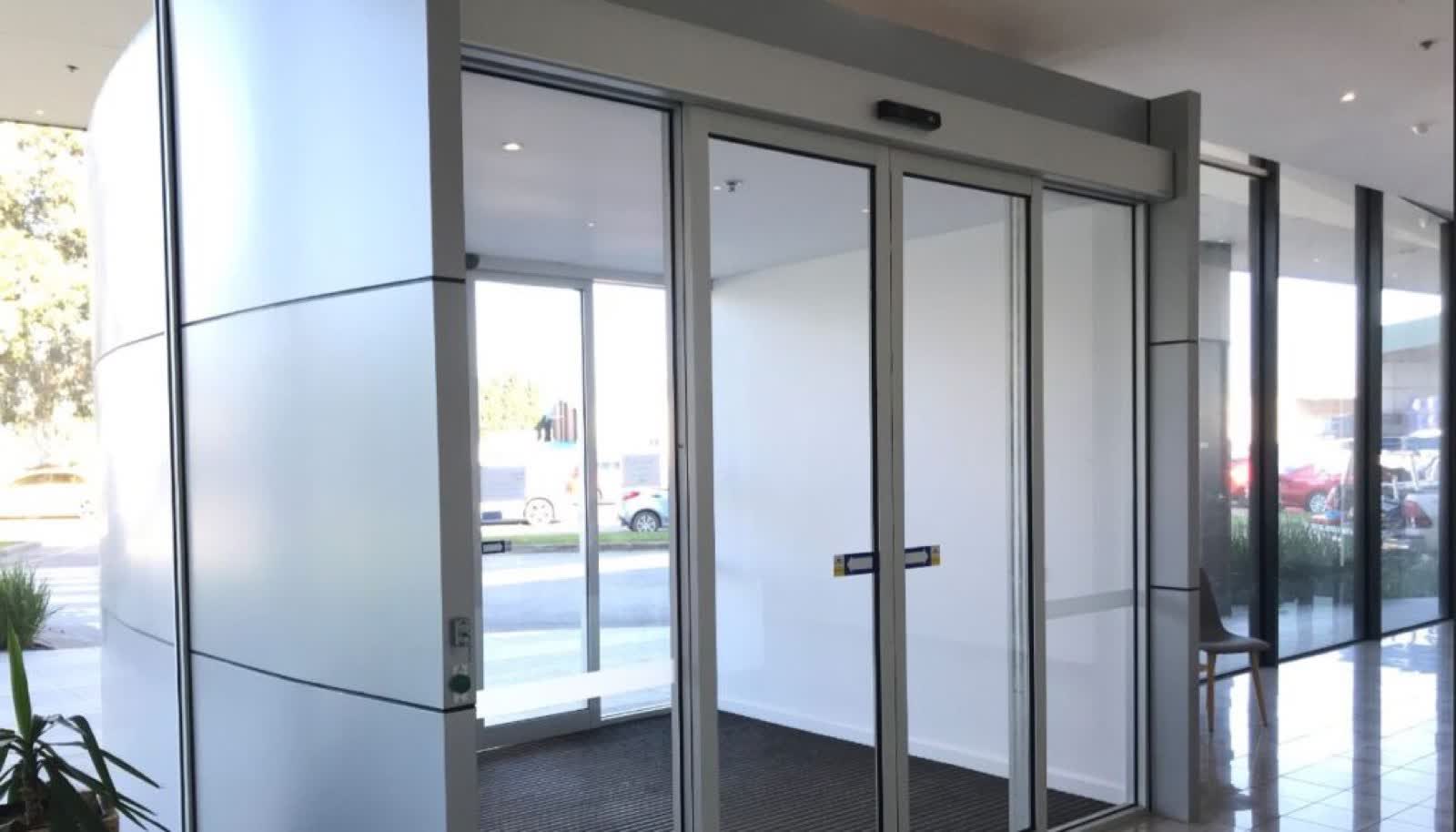
A warehouse pedestrian door lives a harder life than a retail entrance ever will. It runs in air full of cardboard dust and concrete grit, it gets hit by weather every time a dock door rolls up, and it shares floor space with forklifts and pallet jacks that do not slow down for glass. Then the same door gets scheduled for the same once-a-year look as the front door of an office building. That mismatch is why so many industrial automatic doors in Arkansas fail early.
Dust and Grit Do the Damage Long Before Anything Breaks
In a distribution center, a fabrication shop, or a poultry or food plant, the air carries fine material all day. That material settles into sliding door tracks, packs around bottom guides, coats sensor lenses, and works its way into rollers and bearings. Nothing announces itself. The door just gets a little louder, a little slower, and a little rougher until a roller flat-spots or the operator starts working against friction it was never sized for.
Motor and belt wear on a dusty door is usually a symptom, not the cause. A clean track means the operator only has to move the door. A loaded track means it fights the grit too, and it loses that fight sooner than the manufacturer expected.
Cycle Counts Tell You the Real Service Interval
Doors wear by cycle, not by calendar. A break room or shipping office door beside a busy dock can see more openings before lunch than a small storefront sees in a week. Two doors installed the same day in the same building can be at completely different points in their service life depending on which one the crews actually use.
Many commercial operators track cycles internally, and a technician can read that count during a service visit. It turns scheduling into something factual instead of a guess. A few things worth writing down for each opening:
- Where the door sits relative to dock doors, grinding, cutting, or bagging operations
- Roughly how many people move through it per shift, and how many shifts you run
- Whether carts, hand trucks, or pallet jacks pass through it
- The operator's cycle count at each service visit, so you can see the trend
- What went wrong last time, and how long the door was down
The doors that earn quarterly attention then separate themselves from the ones that are fine twice a year.
Guarding: Keep Equipment Away From the Opening
The single most expensive industrial door problem is impact. A forklift clips a jamb, a pallet corner catches a slide track, a cart backs into a swing door's arm. The repair is rarely cosmetic: a frame knocked out of alignment throws off the whole system, and misalignment shows up as binding, dragging, and early operator failure.
Physical protection is cheap by comparison. Bollards or pipe guards set outside the door swing, corner guards on exposed jambs, floor striping that keeps equipment traffic on a separate path, and a clearly marked walking route so people are not sharing a lane with a forklift. Where a pedestrian door opens near a truck court or an equipment aisle, that separation matters more than any hardware upgrade you can buy.
Sensors and Safety in a Dirty Building
Sensors are the part of an automatic door that a dusty environment attacks hardest. A film on a lens or a coated presence sensor changes how the door sees people, so it either stops reacting properly or nuisance-cycles all day, burning service life for nothing. Wiping lenses clean is a housekeeping task and belongs on the same list as sweeping the area.
Adjusting them is not. Sensor aiming, hold-open timing, opening and closing speed, and closing force are safety-critical settings on any powered door, and they belong to an AAADM-certified technician with the manufacturer's specifications and the right tools. In an industrial building with gloves, hard hats, carts, and constant movement, a door set slightly wrong is a genuine hazard. If a door in your plant is closing on people, reversing at random, or opening only sometimes, take it out of service and get a technician on it.
Match the Plan to the Abuse
An industrial maintenance plan should look different from a retail one. That usually means more frequent visits on the high-cycle openings, track and guide cleaning treated as a scheduled task rather than a favor, a safety check at every visit, wear parts like rollers, guides, seals, and belts stocked or at least identified ahead of time, and written records so you can see which doors keep coming back. Documentation also settles the replace-versus-repair conversation quickly, because the service history shows plainly when a door has stopped being worth patching.
CSC Automatic Doors has served central Arkansas businesses since 1976, and we handle pedestrian automatic doors in warehouses, plants, and distribution centers across Little Rock, Conway, North Little Rock, Benton, Bryant, Maumelle, Jacksonville, Searcy, Russellville, Cabot, Sherwood, and Hot Springs. If your industrial doors are on the wrong service schedule for the work they actually do, call us at 501-548-2374 and we will walk the openings with you.
Frequently asked questions
How often should a warehouse pedestrian door be serviced?
More often than a retail entrance. Cycle count and environment drive the interval, so a door beside a busy dock in a dusty plant may need quarterly attention while a low-traffic office door in the same building is fine twice a year. A technician can read the operator's cycle count at each visit, which lets you set the schedule on real usage instead of a guess.
Can our maintenance crew clean the tracks and sensors themselves?
Cleaning is fine and helps a lot. Sweeping and vacuuming the track, clearing the bottom guides, and wiping sensor lenses are housekeeping tasks your team can do. Adjusting sensors, timing, speed, force, or anything electrical is different - those are safety-critical settings that should only be handled by an AAADM-certified technician.
What is the best way to protect an automatic door from forklift damage?
Keep the equipment away from the opening. Bollards or pipe guards outside the door swing, corner guards on exposed jambs, floor striping that routes forklift traffic away from the pedestrian path, and a marked walking route all cost far less than realigning a struck frame. Impact damage usually knocks the frame out of alignment, and that misalignment is what kills the operator early.