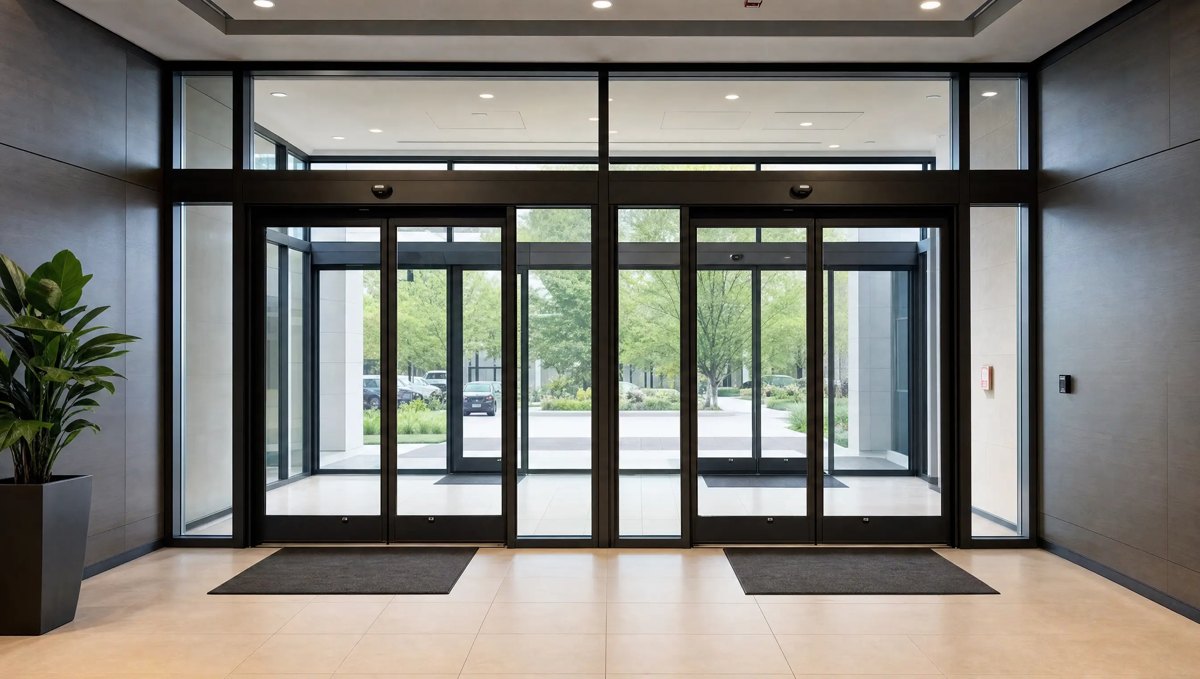
A vestibule is two sets of doors with a small buffer space between them, and the whole point is that the inner and outer doors don't operate like one big opening. When they're timed correctly, only one set opens at a time, holding back Arkansas summer heat and winter cold while people move through comfortably. When they're not timed right, you get a straight-through wind tunnel that defeats the reason the vestibule exists in the first place.
Why Vestibules Get Built in the First Place
Facility owners in Little Rock, Conway, and around central Arkansas add vestibules for a simple reason: a single door swinging or sliding open connects conditioned indoor air directly to the outside. In July that means air conditioning pouring out the front door. In January it means cold air rushing in every time someone walks through. A vestibule creates an airlock effect — but only if the doors are set up to work as a pair instead of independently.
The Interlock: One Door Waits for the Other
An interlock is the logic that keeps the outer door from opening while the inner door is still open, and vice versa. Done well, someone walking in from the parking lot triggers the outer door, steps into the vestibule, the outer door closes, and only then does the inner door open. Done poorly, both doors sense a person at roughly the same time and pop open together, and the vestibule stops doing its job.
- Reduces the amount of time outside air and inside air are directly connected
- Cuts down on drafts that make entry lobbies uncomfortable for staff working near the doors
- Helps conditioned air stay where it's paid for, especially during Arkansas's long cooling season
- Gives foot traffic a predictable, one-set-at-a-time flow instead of two doors competing for the same person
Getting that sequencing right involves the door operators, the control logic, and the sensors all agreeing on what's happening in a tight space — that calibration is a job for a certified AAADM technician with the right testing equipment, not a matter of flipping a switch on-site.
Sensors That Get Confused by the Vestibule Itself
The vestibule's small footprint is exactly what makes sensor placement tricky. Motion and presence sensors on the inner door can pick up movement or a person standing at the outer door and fire early. Glass, metal frames, and reflective flooring inside the vestibule can bounce signals in ways a sensor in an open lobby would never see. The result is doors that open when no one's actually at that door, or that stay confused about whether the space between them is occupied.
- Inner sensor triggering off activity at the outer door (or the reverse)
- False triggers from reflective surfaces common in vestibule finishes
- Sensor zones overlapping in a space too small for the factory-default settings
- A door that reopens right as it's about to close because it's still "seeing" someone in the adjacent zone
Fixing sensor confusion in a vestibule usually means adjusting sensor zones and sensitivity to fit the specific dimensions of that space — again, work for a certified technician, since it touches the same safety-critical settings that govern how the doors respond to people standing near them.
What This Looks Like for the People Using the Building
For retail entries, healthcare lobbies, and hospitality front doors across central Arkansas, a properly timed vestibule is mostly invisible when it's working — customers walk through without noticing anything, staff aren't fighting drafts at the front desk, and the HVAC system isn't fighting the weather every time the door cycles. It's the malfunctioning vestibule that gets noticed: doors that hang open, a blast of heat or cold that follows people to the second door, or a hesitant open-close-open that makes an entrance feel unreliable.
Keeping It Tuned Over Time
Interlock timing and sensor settings aren't a one-time install-and-forget item. Seasonal temperature swings, changes in flooring or entry mats, new signage or displays near the doors, and normal wear on operators can all shift how the doors behave. Routine service visits from a certified technician catch that drift before it turns into stuck doors, false triggers, or a vestibule that's quietly stopped doing its job.
Let's Look at Your Vestibule
If your two-door entry doesn't feel like it's holding back the weather the way it should, or one set seems to open before the other has finished, CSC Automatic Doors can take a look. We work on commercial vestibule and automatic door systems across Little Rock, Conway, North Little Rock, Benton, Bryant, Maumelle, Jacksonville, Searcy, Russellville, Cabot, Sherwood, and Hot Springs. Call 501-548-2374 to schedule a visit.
Frequently asked questions
Why do both sets of doors in our vestibule sometimes open at the same time?
This usually points to sensor overlap or interlock logic that isn't accounting for the small size of the vestibule. It's a setting issue that a certified AAADM technician can diagnose and correct with proper testing equipment.
Does a vestibule actually make a difference in our energy bills?
A vestibule that's timed correctly limits how often outside and inside air connect directly, which helps conditioned air stay inside during hot Arkansas summers and cold winter snaps. The comfort and energy benefit depends on the doors being sequenced properly, not just having two sets of doors.
Our vestibule door reopens right when it's about to close — what's causing that?
That's typically a sensor picking up motion or a reflection it's reading as a person still in the doorway. Diagnosing whether it's sensor placement, sensitivity, or a reflective surface in the vestibule takes a certified technician's inspection.