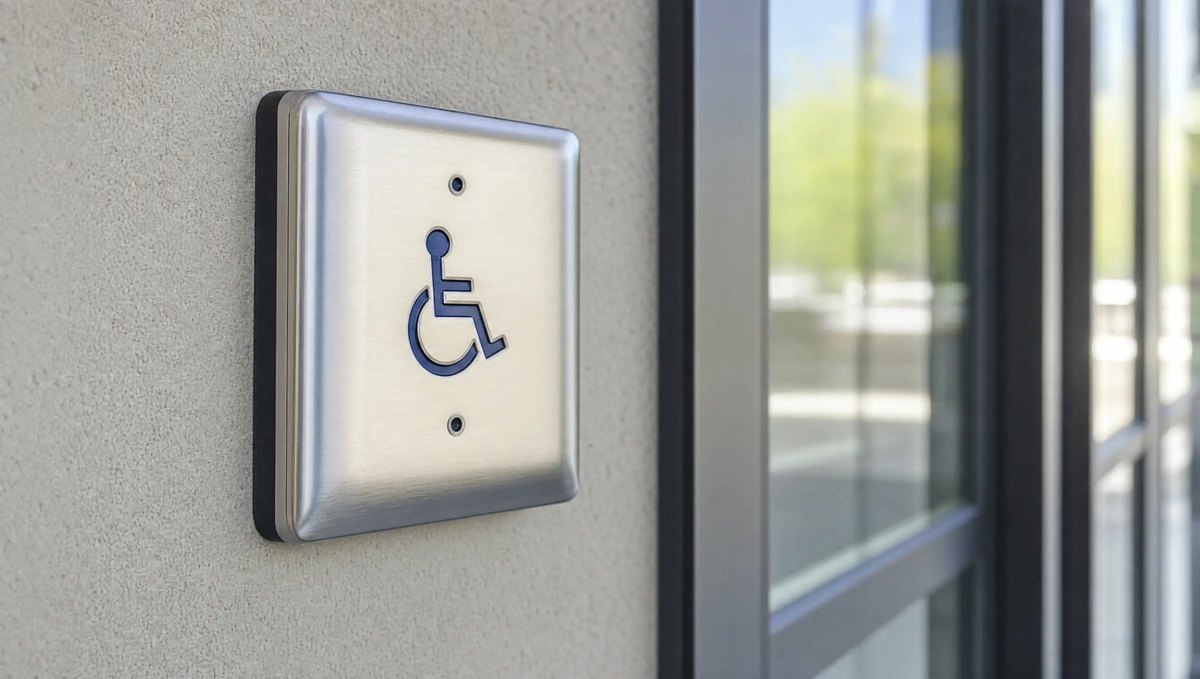
Wave-to-Open Sensors vs. Push Plates
Both wave-to-open sensors and push plates activate an automatic door without pulling or pushing on a handle. The difference is contact. A push plate still requires a hand, elbow, or hip to press a surface that hundreds of other people touch every day. A wave sensor reads a hand or arm moving in front of it from a short distance away, so the door opens without anyone touching a fixture at all.
Push plates still make sense in some settings — they're simple, durable, and easy for kids and visitors to understand at a glance. Wave sensors are the better fit where minimizing contact is the priority, or where a business wants a cleaner, more modern feel at the entrance. Many facilities in Little Rock, Conway, and North Little Rock run both: overhead motion sensors for general traffic and a wave switch mounted near the door for a manual override.
Why Hygiene Matters in Clinics and Food Service
Healthcare offices, urgent care clinics, and restaurant kitchens deal with hands that are gloved, full, sanitized, or contaminated all day long. A touchless door sensor removes one more shared surface from the path between exam rooms, waiting areas, and back-of-house doors. For food service, a wave switch on a walk-in cooler or prep area door lets staff open it with a forearm when their hands are full or freshly washed.
Front-entrance wave sensors send a similar signal to customers and patients — the business has thought about touchpoints, even if it's a small detail. It's a low-cost upgrade with a clear, practical payoff for hygiene-conscious environments.
Getting the Range Right
Every wave sensor has an adjustable detection range — how far a hand or arm needs to be from the unit before the door responds. Set the range too short, and people end up waving awkwardly close to the sensor or giving up and pushing the door open by hand anyway, which defeats the purpose. Set it too wide, and the sensor starts responding to anyone walking past in the hallway or lobby, not just the person trying to use the door.
Range, sensitivity, and door timing all work together with the operator's force and speed settings. Because those settings affect how the door behaves around people, adjustments should be handled by a certified AAADM technician with the right testing equipment — not guessed at in the field. CSC's technicians dial in the range so the sensor responds to an intentional wave without becoming a nuisance trigger.
False Triggers From Passing Traffic
A wave sensor aimed or ranged incorrectly can pick up motion that was never meant to open the door — a cart rolling by, a line of customers queued nearby, or foot traffic in a busy corridor. Beyond the annoyance, doors that open and close on their own all day put extra wear on the operator and shorten the life of the unit.
- Sensors mounted too close to a busy aisle or checkout line
- Detection range set wider than the actual door swing area needs
- Units aimed toward a hallway instead of the doorway itself
If your entrance seems to be opening for people who have no intention of walking through, that's worth a service call. It usually points to a mounting position or range setting that needs correcting, not a sensor that needs replacing.
Mounting Height for Wheelchair Users
A wave sensor mounted too high can be out of easy reach for someone using a wheelchair or scooter, which forces them to either stretch awkwardly or find another way in. Mounting height matters just as much as detection range for making an entrance genuinely usable by everyone who walks — or rolls — up to it.
This is another setting best left to a certified technician who can position and test the unit against the actual door and approach at your building, rather than relying on a one-size-fits-all install.
Whether you're outfitting a new clinic entrance, replacing worn push plates in a restaurant, or fixing an automatic door that keeps opening on its own, CSC Automatic Doors can help. Call us at 501-548-2374 to talk through touchless sensor options for your building in Conway, Little Rock, or anywhere in central Arkansas.
Frequently asked questions
Can a wave sensor replace a push plate entirely?
Often yes — a wave sensor can handle the same job as a push plate without requiring contact. Some businesses still keep a push plate as a backup, especially at exits that see heavy or unpredictable traffic.
Why does our automatic door open when no one is trying to use it?
This is usually a range or mounting issue causing the sensor to pick up nearby foot traffic. A certified AAADM technician can inspect the sensor's aim and detection settings and correct it.
Can we adjust the sensor range ourselves if it seems off?
We don't recommend it. Range works together with the door's force and timing settings, which are safety-critical. Any adjustment should go through a certified AAADM technician with proper testing equipment.