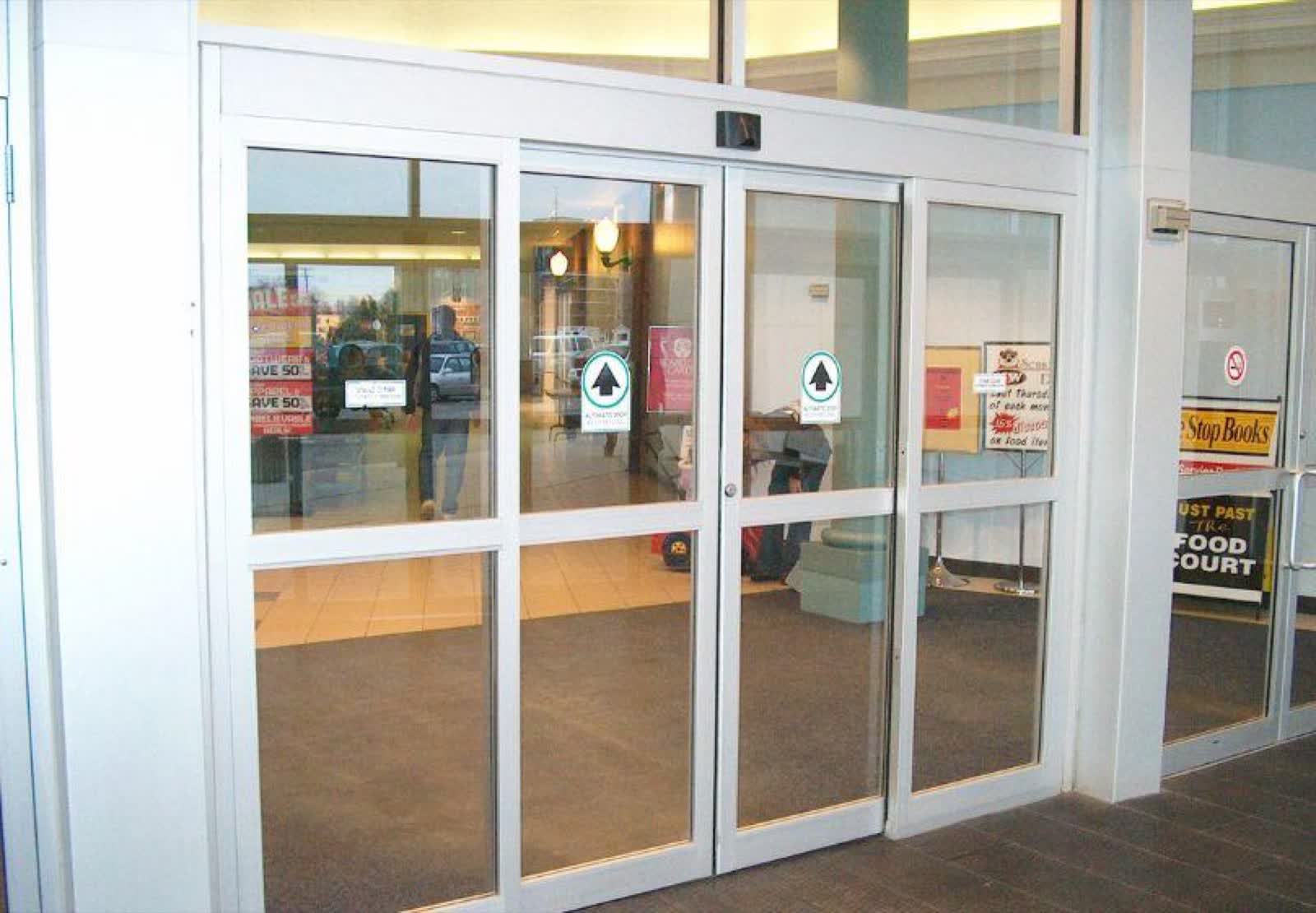
Not every entrance has a wide stretch of wall to work with. Older storefronts, renovated lobbies, and corridors squeezed between existing structural walls often need a wider clear path than the available opening seems to allow. A telescoping automatic sliding door is built for exactly that problem, and it's one of the first options we look at when a central Arkansas business is retrofitting an entrance instead of building new.
How a Telescoping Slider Clears More Opening
A standard two-panel sliding door has each leaf travel about the same distance before they meet in the middle. A telescoping door changes that by linking two or more panels on the same side so they nest together as they slide into the wall pocket. The lead panel and the trailing panel move in tandem but at different speeds, stacking nearly flush against each other at the open position. The result is a clear path that's noticeably wider than what a same-size standard slider could offer, because more of the panel glass tucks away into the pocket instead of staying out in the opening.
The tradeoff is pocket depth. Telescoping panels need a wall cavity on each side (or one side, for a single-telescoping configuration) deep enough to hold the stacked leaves. That's a measurement worth checking early, since it determines whether telescoping is even possible on a given wall.
Where Telescoping Doors Earn Their Keep in a Remodel
Telescoping sliders tend to make the most sense when the building's footprint is already fixed and widening the opening isn't realistic. We see this most often in:
- Retail storefronts where the entrance bay was framed decades ago and can't be widened without touching structural walls or the facade
- Healthcare and senior living corridors that need a wider clear path for wheelchairs, walkers, or gurneys but only have a standard-width opening to work with
- Hotel and restaurant lobbies where the design calls for a narrow-looking storefront that still needs to pass a lot of foot traffic, carts, or luggage
- Office buildings adding accessible entrances during a renovation without reframing the entry wall
In each case, the goal is the same: get more usable opening out of the same footprint instead of paying for construction to widen the wall.
More Panels, More Moving Parts to Maintain
A telescoping door isn't just a wider version of a standard slider — it's a more mechanically involved system. Linking two panels per side usually means an added belt or cable connection, extra rollers, and additional track hardware to keep both leaves synchronized. Every one of those added parts is something that can wear, stretch, or slip out of adjustment over time, and a telescoping door that falls out of sync will bind, close unevenly, or struggle to seat properly in the pocket.
That's why routine inspection matters more on a telescoping configuration than on a simple single-slide door. We're not talking about anything a facility team should attempt themselves — force, timing, and sensor settings on an automatic door are a safety-critical setting, and adjustments belong to a certified AAADM technician with the right testing equipment. What a facility team can do is keep an eye out for early warning signs between service visits: a panel that hesitates, uneven closing, unusual noise from the track, or glass that doesn't fully stack at the open position. Catching those early and calling it in keeps a small adjustment from turning into a bigger repair.
Matching the Opening to Your Traffic
Telescoping doors come in a few configurations — two-panel telescoping, four-panel (telescoping on both sides), and variations in between — and the right one depends on how much width you actually need and how much foot traffic moves through. A low-traffic side entrance might only need a modest telescoping gain, while a main lobby handling steady two-way flow, carts, or wheelchairs may call for the widest clear path a telescoping system can deliver in that wall space.
Before settling on a configuration, it's worth having someone measure the actual wall pocket depth, the traffic pattern at that entrance, and how the door will be used day to day. Oversizing the system adds maintenance points without a real benefit; undersizing it leaves the bottleneck you were trying to fix in the first place.
If you're planning a remodel in Little Rock, Conway, North Little Rock, Benton, Bryant, Maumelle, Jacksonville, Searcy, Russellville, Cabot, Sherwood, or Hot Springs and a narrow wall is limiting your entrance, give CSC Automatic Doors a call at 501-548-2374. We'll look at the opening, the wall space, and your traffic, and help you figure out whether a telescoping slider is the right fit.
Frequently asked questions
Can any existing opening be converted to a telescoping slider?
Not always. Telescoping panels need enough wall pocket depth on one or both sides to stack the nested leaves, so the wall cavity has to be measured before assuming it will fit. A site visit is the quickest way to confirm whether your wall has the room.
Is a telescoping door harder to maintain than a standard sliding door?
It has more moving parts per side — extra rollers, belts, and linkage to keep the panels synchronized — so there are more wear points to check. Facility staff can watch for uneven closing or hesitation, but force, timing, and sensor adjustments should always go to a certified AAADM technician.
How do I know if I need a two-panel or four-panel telescoping configuration?
It comes down to how much clear width you need versus how much wall pocket you have, plus how much foot traffic the entrance sees. A busy two-way lobby usually benefits from the widest configuration the wall allows, while a lower-traffic side entrance may only need a modest telescoping gain.