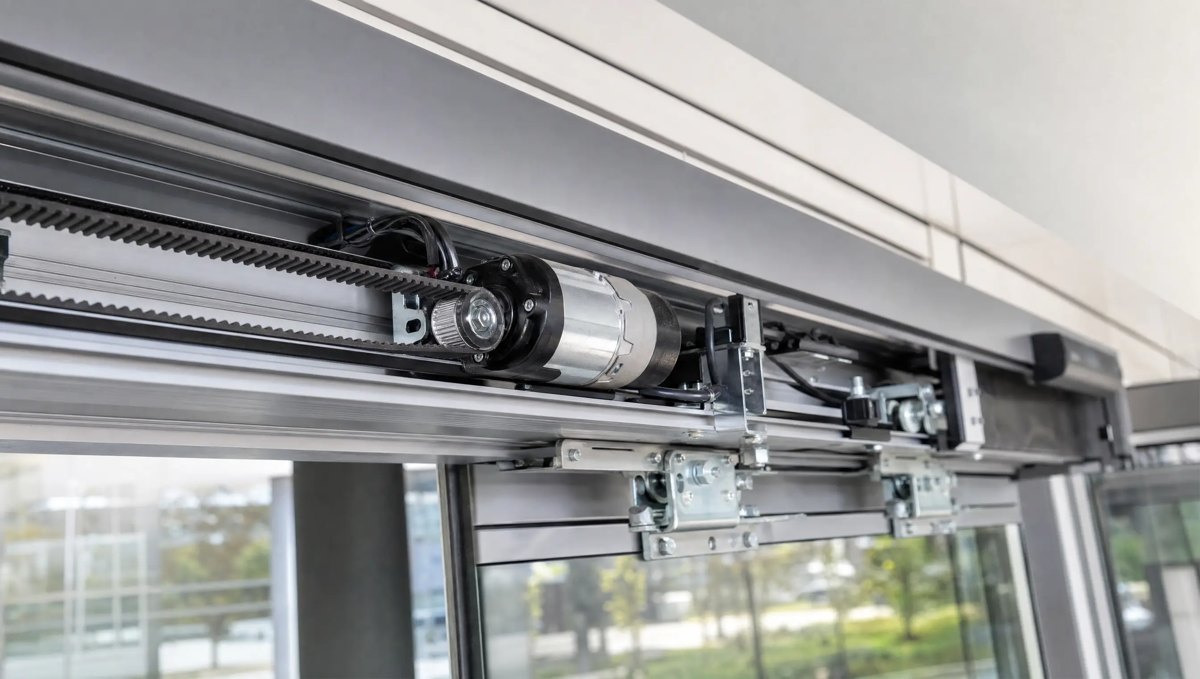
Replacing a worn-out swing door operator or speccing one for a new entrance means facing a choice that affects how the door swings and how long the system lasts: push arm or slide arm. Both let the operator push or pull the door open and closed, but they do it differently, and that difference matters for headroom, frame design, and wear over time. Here's what facility managers around Little Rock, Conway, and North Little Rock should know before deciding.
Push Arm vs. Slide Arm: What's the Difference
A push arm (sometimes called a standard arm or track arm with a rigid link) connects the operator directly to the top of the door with a jointed arm, similar to how your own arm would push a door open. As the operator rotates, the arm extends and pivots, swinging the door through its full arc. It's a straightforward mechanical connection, and it's been the standard setup on countless commercial entrances for decades.
A slide arm, also called a slide-track arm, uses a different geometry. Instead of a jointed arm pushing directly, a shoe or roller rides inside a track mounted across the top of the door, letting the arm slide as the door swings. This changes the leverage and path the arm travels, which is why slide-track setups are often chosen for specific frame or clearance situations rather than as a general-purpose default.
Neither type is universally "better" — the right choice depends on the opening, the traffic it sees, and the mounting conditions above the door.
Which Side of the Door Does the Operator Mount On?
Arm type also determines where the operator box has to sit relative to the door and frame. Push-arm setups are typically mounted on the frame side opposite the swing, pushing the door away from the operator as it opens. Slide-arm setups can sometimes be mounted on the same side the door swings toward, which is useful when the header or adjacent wall doesn't leave room for a push-side installation.
This isn't a detail to guess at. Mounting side affects how the door interacts with adjacent doors, sidelights, vestibules, and traffic flow, and it has to be worked out before the operator goes in. A certified technician will look at your opening — swing direction, header depth, and what's on either side of the frame — before recommending which arm and mounting side fits.
Headroom and Frame Limits
Every operator and arm combination needs a certain amount of clear space above the door to mount the unit and let the arm travel through its full range of motion. Push arms generally need standard header depth. Slide-track arms can sometimes work with tighter headroom in one direction but require enough horizontal track length across the top of the frame in the other.
Older storefronts, retrofits, and buildings with transom windows or signage right above the door frequently run into these limits. Before committing to either arm type, the header depth, frame material, and anything already mounted above the opening need to be measured against the manufacturer's installation limits. Forcing an operator into a header that's too shallow, or a track into a frame that's too short, is a common cause of early operator failure.
Why Arm Choice Affects Long-Term Reliability
The arm takes direct mechanical stress every time the door cycles — hundreds of times a day at a busy entrance. A push arm installed correctly, on a frame it's rated for, transmits force cleanly and wears evenly. A slide-track arm forced into the wrong header clearance, or a push arm mounted at the wrong angle to compensate for a tight frame, puts uneven stress on the linkage, the track, and the operator motor.
- Mismatched arm-to-frame fit shows up as grinding, binding, or a door that doesn't close fully.
- Incorrect mounting angle accelerates wear on bushings and pivot points.
- An arm fighting its own geometry puts extra load on the operator, shortening its service life.
This is why arm selection isn't a cosmetic decision — it's a reliability decision made at install time. Adjustments to closing force, speed, and timing are safety-critical settings that belong to a certified AAADM technician with the right testing equipment, and the same goes for deciding which arm type and mounting configuration your entrance actually needs.
Getting the Right Setup for Your Entrance
For retail entries, medical offices, hotel lobbies, and any other high-traffic commercial door in central Arkansas, matching the arm type to the frame and header is what keeps a swing door operator running smoothly for years instead of needing repeat service calls. Whether you're planning a new accessible entrance or replacing an operator that's been fighting the wrong setup, it's worth having someone look at the frame before parts get ordered.
CSC Automatic Doors has been serving businesses across central Arkansas — Little Rock, Conway, North Little Rock, Benton, Bryant, Maumelle, Jacksonville, Searcy, Russellville, Cabot, Sherwood, and Hot Springs — since 1976. If you're deciding between a push arm or slide arm for your swing door operator, or your current setup isn't holding up, call us at 501-548-2374 and we'll take a look.
Frequently asked questions
Can a push-arm door be converted to a slide-track arm, or vice versa?
Sometimes, but it depends on whether the frame and header have the clearance the new arm type needs. A certified technician should check the opening before any conversion is quoted.
Why does my entrance need more headroom than the door next to it?
Different operator and arm combinations need different amounts of clear space above the door to travel through their full range of motion, so two similar-looking entrances can have different headroom needs depending on the equipment installed.
How do I know which arm type is already on my door?
A push arm connects to the door with a jointed, rigid link, while a slide arm rides in a track mounted across the top of the frame. If you're not sure which one you have or whether it's the right fit, a certified technician can confirm it during a service visit.