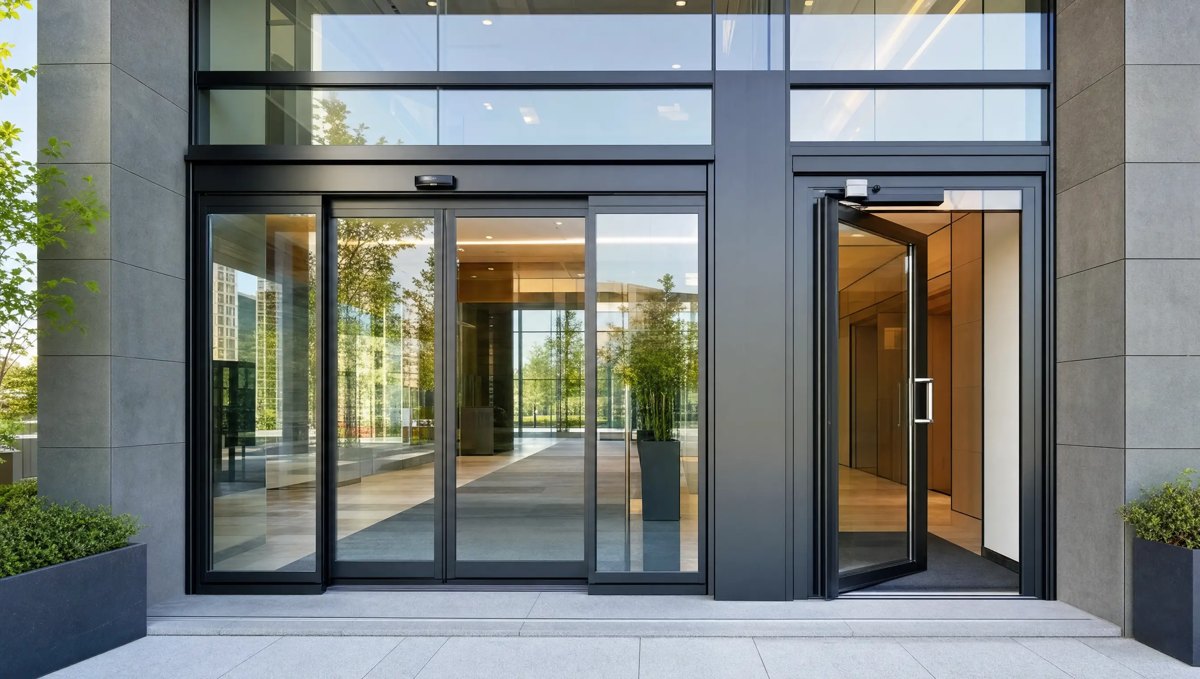
Both sliding and swing automatic doors move people through your entrance without hands on a handle. But they solve different problems, and the wrong choice can mean crowded doorways, wasted floor space, or higher energy bills for years. If you run a business in central Arkansas, here's how the two compare on the factors that actually matter.
How Each Door Works
An automatic sliding door parts in the middle (or slides to one side) along a track, staying parallel to the wall as it opens. It never sweeps into the path of traffic. An automatic swing door pivots on hinges like a standard door, opening inward or outward when triggered by a sensor or push plate.
That basic difference in motion drives almost every decision below.
Traffic Volume
Sliding doors are built for heavy, two-way, continuous foot traffic. Grocery stores, pharmacies, hospitals, and busy retail entrances lean on them because people can flow through in both directions without waiting for a panel to swing clear. The wide clear opening also handles carts, wheelchairs, and gurneys with room to spare.
Swing doors work best where traffic is lighter or more intermittent — an office lobby, a clinic side entrance, a boutique, or a restaurant. They're also the practical choice for a single-person accessible entrance where a push plate does the job without a full sliding system.
Available Space
This is often the deciding factor. A swing door needs clear floor space in the arc where the panel travels, plus a safe zone so it doesn't strike anyone entering or exiting. In a tight vestibule or a narrow storefront, that arc can be a real problem.
- Sliding doors keep all motion parallel to the wall, so they're ideal where floor space is limited or the entry is crowded.
- Swing doors need swing clearance, but they can fit openings where a sliding track and side panels won't.
Weather and Energy
Central Arkansas gives you hot, humid summers and cold snaps in winter, so how a door handles the elements matters. Sliding doors typically pair with a vestibule and can be set to open only as wide and as long as needed, which helps limit the amount of conditioned air escaping every cycle. Many sliding systems also seal well when closed.
Swing doors can let in more outside air during their open cycle, especially at a high-traffic entrance, and wind load is a genuine consideration — a gust can push against a swing panel. In exposed entrances, that affects both comfort and the wear on the operator over time.
Cost Factors
We won't quote numbers here because every entrance is different, but it helps to know what drives the price on either option. Sliding systems usually involve more components — the track, multiple panels, header, and sensors — so the upfront investment is generally higher than a comparable swing setup. Swing operators are often simpler to install on an existing frame.
Weigh the long game, too. A door matched to your traffic and space tends to need fewer adjustments and lasts longer, while a mismatched door gets pushed, forced, and worn faster. Ongoing energy performance and maintenance frequency belong in the total-cost picture, not just the install.
A Quick Guide by Business Type
- Grocery, pharmacy, big-box retail: sliding — high two-way traffic and cart clearance.
- Hospitals and clinics: sliding for main entrances; swing for interior or single accessible doors.
- Offices and professional buildings: swing for lobbies with moderate traffic.
- Restaurants and hospitality: either, depending on entry width, vestibule design, and the look you want.
- Tight or narrow storefronts: sliding, to reclaim the floor space a swing arc would eat.
Get the Setup Right — and Kept Right
Whichever door you choose, the safety-critical work isn't a DIY job. Opener force and timing, sensor placement, and electrical connections all have to be set and maintained by a certified AAADM technician to meet safety standards and keep people from getting hurt. Improper adjustment is one of the most common causes of door incidents, and it's exactly what a professional inspection is meant to catch.
Not sure which door fits your entrance? The team at CSC Automatic Doors has served central Arkansas businesses since 1976 and can walk your site, weigh your traffic and space, and recommend the right system. Call us at 501-548-2374 to talk it through.
Frequently asked questions
Are sliding automatic doors more energy-efficient than swing doors?
Often, yes. Sliding doors can be set to open only as wide and as long as needed and typically pair with a vestibule, which limits how much conditioned air escapes each cycle. In Arkansas's hot summers and cold snaps, that can matter for a high-traffic entrance. Your building layout and how well the door is sealed and maintained make the real difference.
Which automatic door is better for a tight or narrow entrance?
A sliding door, in most cases. Its panels move parallel to the wall, so there's no swing arc eating into your floor space or crowding people at the doorway. A swing door needs clear room in the path where the panel travels, which is hard to spare in a small vestibule or narrow storefront.
Can I adjust the speed or sensors on my automatic door myself?
No. Opener force and timing, sensor placement, and electrical work are safety-critical and should only be handled by a certified AAADM technician. Improper adjustment is a leading cause of door incidents. Call CSC at 501-548-2374 to schedule a professional service or inspection.