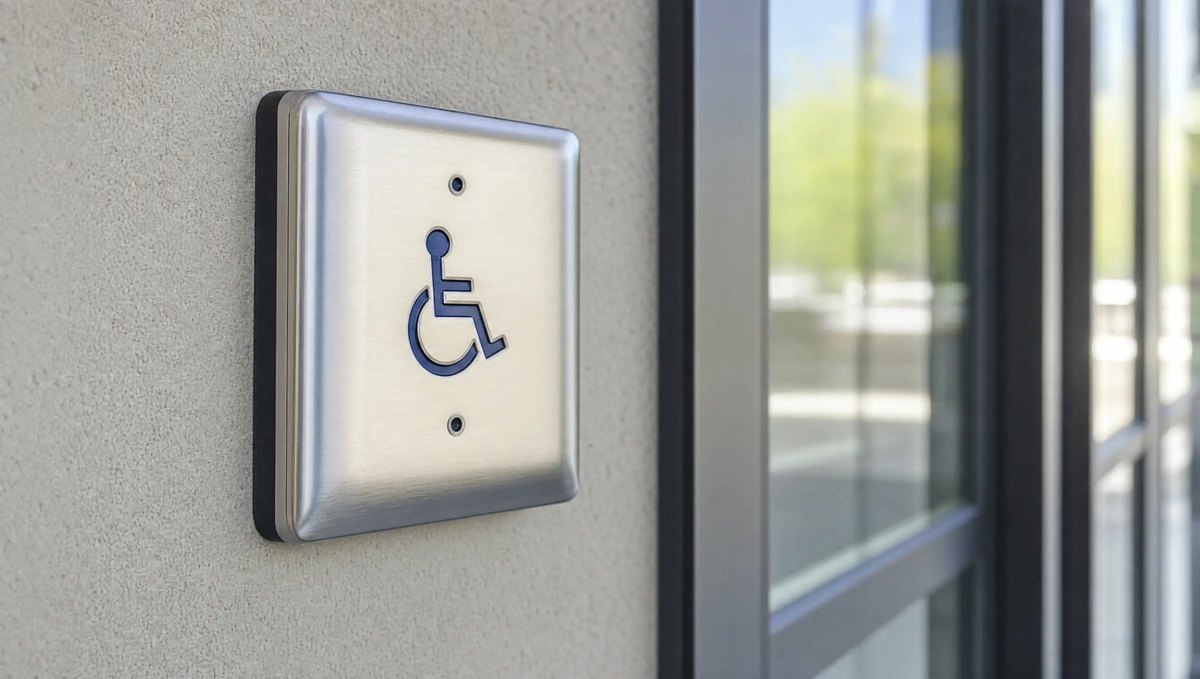
Why Push Plate Placement Matters More Than It Looks
An automatic door only works for everyone if the button that opens it is somewhere everyone can actually use. We get called out more often than you'd think to fix a push plate that landed in the right general area but the wrong exact spot — mounted too high, set too far from the door, or tucked behind a planter where a wheelchair user can't get close enough to press it. Placement isn't an afterthought once the operator is installed; it's part of making the entrance actually work.
Mounting Height and Distance from the Swing Path
Two things determine whether a push plate is usable: how high it sits on the wall or bollard, and how far it sits from the door itself.
- Height needs to work for someone seated in a wheelchair or scooter, without forcing a reach or a stretch. An installer should set the plate to the manufacturer's mounting specs and accessible reach guidelines for that operator and plate — not a height that just looks right standing up.
- Distance from the door matters just as much as height. A plate mounted too close puts a person right in the door's swing path the moment they press it. A plate mounted too far away means crossing open floor to reach the button, then hustling back before the door starts moving.
The right spot balances both: close enough to feel connected to the door, far enough that the door swinging open or closed never comes near the person who just pressed the plate.
Bollard-Mounted Plates in Open Lobbies
In open lobbies, atriums, and wide entrances without a nearby wall, the push plate usually goes on a freestanding bollard instead. Bollards solve the missing-wall problem, but they introduce a new one: placement in open floor space.
- A bollard set too close to the door becomes part of the swing path itself, putting the door in reach of both the plate and the person standing at it.
- A bollard set out in the middle of a busy lobby turns into a trip hazard or a spot where carts and foot traffic collide with it.
- A bollard tucked off to the side, out of the path people naturally walk, gets missed entirely — people don't see it, so they wait for the door to trigger on its own or push on the glass instead.
Good bollard placement puts the plate where someone walking toward the door will naturally see and reach it, clear of both the swing path and the main traffic lane.
When the Plate Is Out of Reach
We still find plates mounted at a height or angle that works fine for someone standing, but is awkward or impossible from a wheelchair — set behind a step, blocked by a planter or furniture, or angled into a corner a wheelchair can't turn into. If someone has to lean, twist, or ask for help to press the button that opens the door, the placement isn't doing its job.
It's worth walking the approach yourself, in a wheelchair or scooter if you have one on site, or by approaching from the angle someone using a mobility device would take. If you can't get square to the plate and press it without stretching, it needs to move.
The Swing-Strike Problem
The swing-strike problem is the most serious placement mistake: a push plate positioned so the door itself can strike the person who just pressed it. This happens when the plate sits too close to the arc the door travels through, or on the side where an outswinging door swings toward the plate rather than away from it.
- Someone presses the plate, the door begins to open, and the leading edge swings directly toward where they're standing.
- On a double-door setup, this can happen on either side if plates weren't mapped against both doors' swing direction.
This isn't something to fix with a screwdriver and a guess. Correct standoff distance depends on the door's swing radius, the operator's settings, and the plate's exact position — and any change to how the door reacts to the plate is safety-critical work that belongs to a certified AAADM technician with the right testing equipment.
Get Your Placement Checked
If you're planning a new automatic entrance, remodeling a lobby, or you've just never been sure your existing push plates are mounted where they should be, CSC Automatic Doors can walk your entrance and tell you straight whether the placement works — height, distance, bollard position, reach, and swing clearance included. We've served central Arkansas businesses since 1976, from Little Rock and Conway to Hot Springs and Searcy. Call us at 501-548-2374 to get your entrance checked out.
Frequently asked questions
How high should a push plate be mounted?
There's a specific height range designed for someone seated to reach comfortably without stretching. Your installer should set the plate to the manufacturer's mounting specs for the operator and plate you're using, rather than eyeballing a height that looks right standing up.
Can a push plate be mounted on a bollard instead of a wall?
Yes — bollard-mounted plates are common in open lobbies and atriums where there's no wall close enough to the door. The bollard needs to sit clear of the door's swing path and out of the main foot-traffic lane so it doesn't become a hazard itself.
What is the swing-strike problem with push plates?
It's when a push plate is close enough to the door that the door itself can swing into the person who just pressed it. Fixing it involves the door's swing radius and operator settings, so it should be evaluated and corrected by a certified AAADM technician.