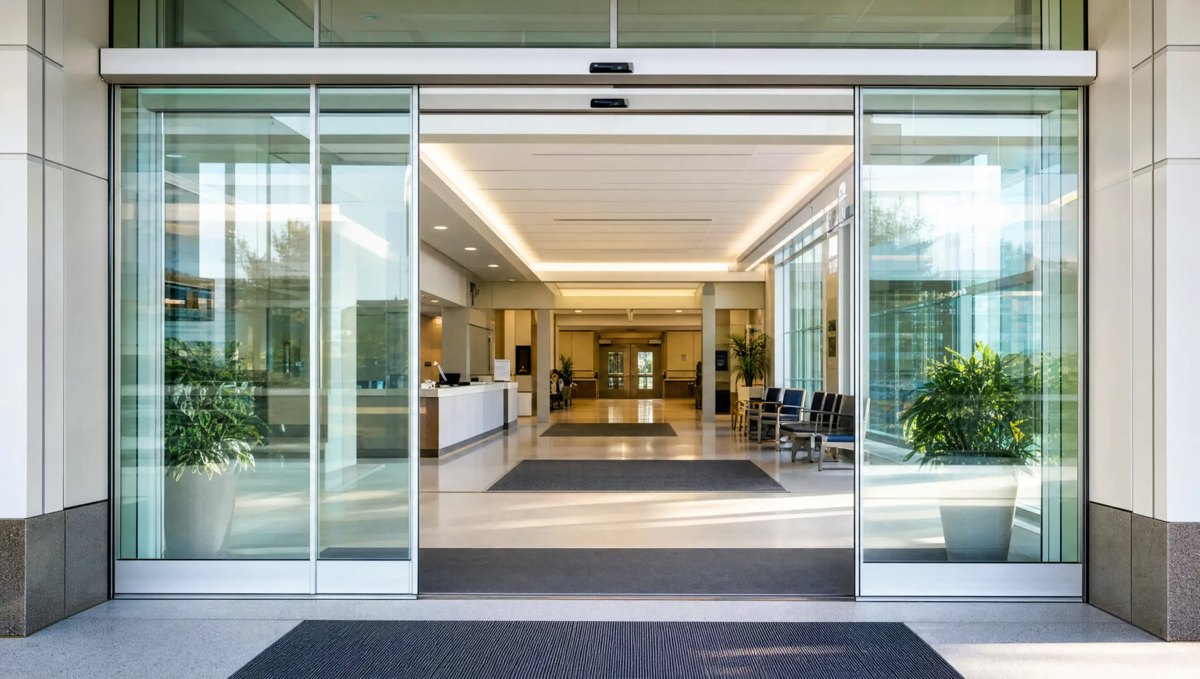
One Building, Many Doors to Manage
A medical office building in Little Rock or Conway rarely has just one automatic door. There's the main entrance everyone walks through, plus individual automatic openers on imaging suites, specialty practices, urgent care entries, and sometimes a back-of-house delivery or pharmacy pickup door. Each one gets used by patients who are tired, in pain, pushing a wheelchair, or managing an IV pole or oxygen tank. When any one of those doors hesitates, closes too fast, or won't open at all, it's not a minor inconvenience — it can stop a patient from getting to an appointment.
For a property manager overseeing a multi-tenant medical building, keeping every door working the same way, on the same schedule, is the real challenge.
The Main Entrance Sets the Tone
The lobby entrance is the first thing every patient, visitor, and vendor interacts with. It needs to open wide enough and hold long enough for someone moving slowly, and it needs to do that reliably through heavy morning traffic, lunchtime lulls, and after-hours urgent visits. Weather stripping, door seals, and sensor alignment all affect how consistent that first impression is — and in a medical setting, a door that's slow or sticky can shake confidence in the whole building before a patient ever reaches a front desk.
Suite-Level Openers Carry Their Own Weight
Suite doors don't see the same foot traffic as the main entrance, but they matter just as much. A physical therapy suite, a lab draw station, or a specialist's office each serves patients who may be moving slower than average, recovering from a procedure, or arriving straight from the main lobby without much time to adjust to a second door. Suite-level operators also tend to get overlooked during routine building upkeep, since they technically belong to the tenant rather than the landlord. That gap is exactly where problems build up unnoticed.
- Push-plate and wave-sensor openers on individual suites
- Low-energy swing operators common in older medical office retrofits
- Sliding entries on larger specialty practices or imaging centers
Patients With Mobility Aids Depend on Consistent Performance
Wheelchairs, walkers, canes, and crutches all move at a different pace and width than regular foot traffic, and a door's opening speed, hold-open time, and swing clearance all need to account for that. These are safety-critical settings, and adjustments belong to a certified AAADM technician working within the manufacturer's limits. What building owners and on-site staff can do is watch for warning signs: a door that closes before someone clears it, one that doesn't fully open, or one that requires a hard push to trigger. Reporting those signs quickly, and getting a technician out before an accessible entrance becomes an unreliable one, is one of the most useful things staff can do between service visits.
Coordinating Door Work Across Tenants
Scheduling service in a medical office building is different from a single-tenant retail space. A main entrance repair affects the whole building; a suite-level repair affects one practice's patients and schedule. Lining up service windows with tenants — especially ones with procedures, imaging appointments, or exam schedules that are hard to move — takes coordination. It helps to have one point of contact who manages the relationship with a door service company, keeps tenants informed of upcoming visits, and makes sure suite-level issues get reported instead of worked around.
One Inspection Record for the Whole Property
With doors owned or used by different tenants, it's easy for inspection history to get scattered — one practice calls its own vendor, another doesn't call anyone until something breaks. For a property manager, consolidating every automatic door on the property into a single inspection record makes it much easier to track what's been serviced, what's overdue, and which doors need attention before they become a problem. A single service relationship covering the main entrance and every suite-level opener keeps that record complete and keeps every tenant's patients moving through doors that work the way they should.
CSC Automatic Doors has serviced commercial automatic door systems across central Arkansas since 1976, working with property managers and tenants in Little Rock, Conway, North Little Rock, Benton, Bryant, Maumelle, Jacksonville, Searcy, Russellville, Cabot, Sherwood, and Hot Springs. Call 501-548-2374 to schedule an inspection for your medical office building or a service visit for a specific suite.
Frequently asked questions
Who is responsible for servicing suite-level automatic doors in a multi-tenant medical building — the landlord or the tenant?
It depends on the lease, and it varies building to building. What matters most is having one clear point of contact who tracks which doors belong to which party so nothing falls through the cracks. CSC can work directly with property managers, individual tenants, or both on the same property.
Can one company inspect every automatic door in our medical office building at once, even across different tenant suites?
Yes. CSC can schedule a single visit covering the main entrance and every suite-level opener in the building, and keep that history in one record for the property manager rather than scattered across individual tenants.
What should on-site staff watch for between inspections on doors used by patients with mobility aids?
Watch for a door closing before someone clears it, a door that doesn't open fully, or one that needs a hard push or extra wait to trigger. Any of those are signs the door needs attention from a certified AAADM technician before it becomes unreliable for patients using wheelchairs, walkers, or other mobility aids.