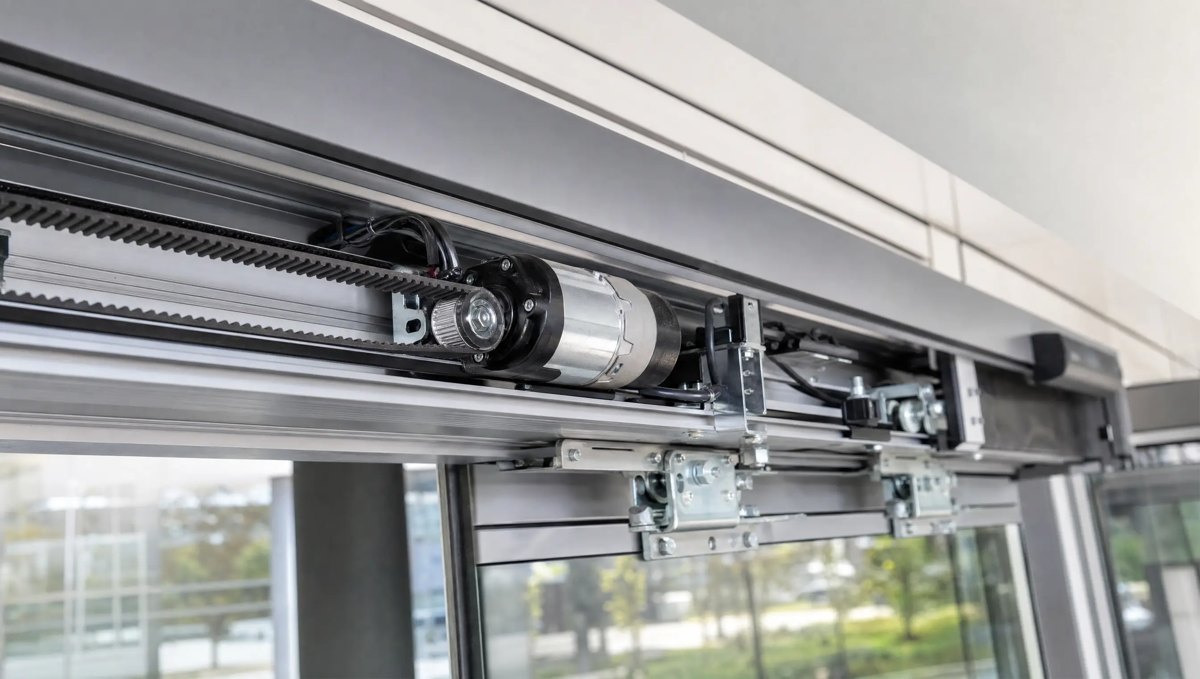
What a Low-Energy Swing Operator Actually Is
A low-energy swing door operator is a powered arm mounted at the head of an existing swing door. It opens the door slowly when someone presses a push plate or wave switch, holds it open for a set number of seconds, then closes it just as slowly. That is the whole job. It is not the fast, sensor-driven package you see at a grocery entrance, and it is not trying to be.
The word "low-energy" describes how the door moves, not how much electricity it uses. The operator is tuned to open and close gently enough that a person standing in the doorway is not knocked off balance. That slower motion is exactly why these units work in places a full-speed automatic door would be wrong.
Where a Low-Energy Operator Fits
We install these across central Arkansas in the same handful of places, over and over, because they solve the same problem every time:
- Office suite entrances and interior lobby doors — moderate traffic, people arriving with laptops, boxes or coffee, and no need for a door that stands open all day.
- Public restrooms — the single most common request we get. A heavy restroom door is hard to pull, and a push plate removes that problem for everyone walking in.
- Clinic and medical office corridors — doors between waiting areas, exam wings and lab corridors, where staff are pushing carts and patients may be using a walker, cane or wheelchair.
- Break rooms, conference rooms and staff entrances — doors used steadily but not constantly.
- Vestibule interior doors — paired with a faster exterior door, or on their own at a secondary entrance.
The common thread is accessible access at a human pace. Nobody is running through these doors. They just need to open without a shove.
Where It Is the Wrong Tool
A low-energy operator is not built for a high-volume retail or grocery entrance where people stream through continuously. It cycles slower and it is activated on purpose, not automatically, so a busy front door will feel like a bottleneck. That situation calls for a sliding package or a full-power swing door with the sensor coverage to match. If you are not sure which side of that line your door falls on, the honest answer comes from looking at the opening and the traffic, not from a catalog.
Push Plates and How People Trigger the Door
Low-energy operators are almost always activated by a person choosing to activate them. The usual options:
- Hard-wired push plates — the classic stainless or blue plate on the wall. The most reliable choice, with no batteries to change.
- Wireless push plates — useful when running wire through a finished wall or across a corridor would mean tearing up drywall.
- Touchless wave switches — you hold a hand in front of the plate instead of pressing it. Popular in clinics, food service and anywhere hand contact is a concern.
- Card readers and access control — the operator can be tied into a badge system so the door only opens for authorized staff.
Plate placement matters more than people expect. Put a plate too close to the door swing and a person who presses it gets hit by the door they just opened. Put it where a cart blocks it and staff stop using it. We set placement based on how the space is actually used, on both the push side and the pull side.
Speed and Force Settings Belong to a Certified Technician
Every low-energy operator has adjustable opening speed, closing speed, hold-open time and closing force. Those are safety-critical settings. Turned up too far, a slow, gentle door becomes a door that can strike someone who cannot get out of the way quickly. Turned down too far, it stalls against normal building air pressure and people start yanking it open by hand, which damages the operator.
There is a right window for those settings, set by the manufacturer for that specific unit and verified with a force gauge and a stopwatch — not by feel, and not by a maintenance employee with a screwdriver. This is why these adjustments belong to a certified AAADM technician with the right testing equipment. The same applies to the arm, the control box, the wiring and any sensor tied into the door. If your door is slamming, creeping, stalling or stopping short, that is a service call, not a dial to turn.
It is also worth having your operators inspected on a schedule rather than waiting for a complaint. Settings drift as an operator ages, weather changes building pressure, and a door that felt fine in March can be closing too hard by August.
Talk to CSC Automatic Doors
CSC Automatic Doors has served central Arkansas businesses since 1976, covering Conway, Little Rock, North Little Rock, Benton, Bryant, Maumelle, Jacksonville, Searcy, Russellville, Cabot, Sherwood and Hot Springs. If you are weighing a low-energy operator for a restroom, an office suite or a clinic corridor — or your existing one is not behaving — call us at 501-548-2374 and we will take a look at the actual opening.
Frequently asked questions
Can I add a low-energy operator to a door I already have?
Often, yes. Many existing swing doors can be retrofitted with a low-energy operator, but it depends on the door, the frame, the header above it and whether power can be brought to the location. A technician needs to see the opening before anyone promises it will work.
Why is my automatic restroom door closing so hard?
Closing force and speed are adjustable settings on the operator, and they can drift over time or be knocked out of range. A door closing harder than it should is a safety issue, so it should be checked and reset by a certified AAADM technician with a force gauge rather than adjusted in-house.
What is the difference between a low-energy operator and a full-power automatic door?
A low-energy operator opens slowly and is triggered on purpose, usually by a push plate or wave switch, which suits offices, restrooms and clinic corridors. A full-power automatic door opens faster and is triggered automatically by sensors, which suits busy main entrances with continuous traffic.