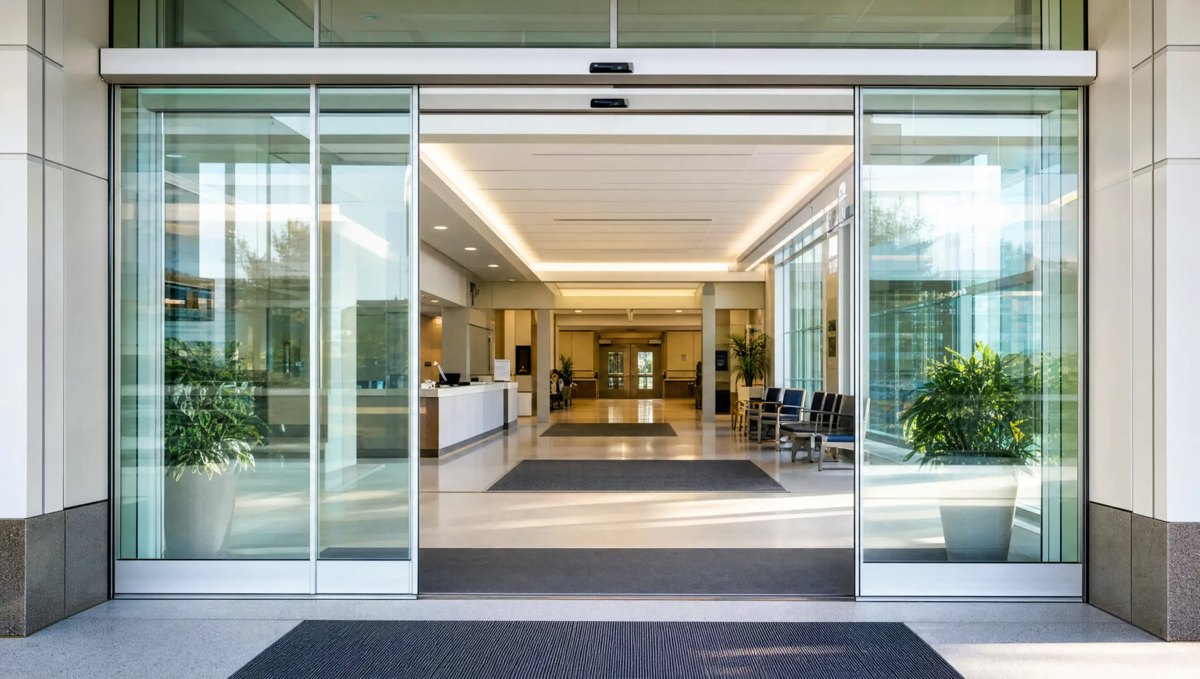
The automatic doors leading into an ICU, isolation room, or operating suite are doing more work than a typical entrance slider. They're holding a pressure relationship between rooms, moving quietly enough not to disturb patients, and opening for a nurse or surgeon whose hands are full or gloved. When one of these openings fails, it's rarely a minor inconvenience — it can disrupt patient flow, room pressure, or a procedure already underway. That's why hospitals and clinics across central Arkansas are better served by a scheduled maintenance plan than by waiting for a breakdown call.
Sealed Doors and Air Pressure Control
Many ICU and OR entrances use sliding doors built with gasket seals or brush seals to help maintain the air pressure relationship engineered for that space. A worn seal, a door that no longer closes fully, or a track full of debris can all let air move where it shouldn't. Facility staff usually don't notice a seal problem until pressure monitoring flags an issue or someone feels a draft near the doorway. Routine inspection of seals, closing force, and full-close position catches this drift before it becomes a bigger facilities problem.
Quiet Operation Where It Matters Most
Motors, belts, and rollers that are perfectly acceptable in a busy lobby can be too loud for a space where patients are recovering or sedated. Over time, worn rollers or a dry track can turn a smooth, quiet slide into a door that squeaks, thumps at the end of travel, or vibrates the frame. In an ICU corridor that gets used dozens of times a shift, that noise adds up. Scheduled lubrication, roller inspection, and track cleaning keep these doors operating the way they were designed to — smoothly and quietly, shift after shift.
Hands-Free Activation for Gowned Staff
Staff moving through ICU and OR doorways are frequently pushing a bed, carrying supplies, or wearing gloves and a gown they don't want to touch a wall plate with. That's why these openings typically rely on motion sensors, wave-to-open plates, or foot switches rather than a simple push-plate. Each of those activation devices needs to be aligned, cleaned, and tested regularly so the door responds reliably every time — not intermittently, and not so sensitively that it triggers on someone simply walking past in the hallway.
Why Breakdown Calls Aren't Enough Here
In a retail entrance, a door that sticks for a day is an annoyance. In a hospital, a door that won't seal, won't open hands-free, or bangs loudly at the end of its cycle can affect infection control, patient rest, or a code response. Waiting for something to fail before calling for service means the facility absorbs that risk in the meantime. A scheduled service visit instead checks closing force, seal condition, sensor alignment, and full range of motion on a set interval — catching wear while it's still a minor adjustment rather than a doorway that's down.
Work That Belongs to a Certified Technician
ICU and OR doors sit in a safety-critical setting, and adjustments to closing force, timing, sensors, or the operator itself belong to a certified AAADM technician with the proper testing equipment — not facilities staff working from a guess. Attempting to tune these settings without the right tools can leave a door closing too fast, too hard, or not sensing an obstruction the way it should. Scheduled service from a qualified technician keeps those settings within the manufacturer's limits while your team focuses on patient care.
Serving Healthcare Facilities Across Central Arkansas
CSC Automatic Doors has served central Arkansas businesses, including healthcare facilities, since 1976. We provide AAADM-certified service for ICU, OR, and other sensitive hospital entrances in Conway, Little Rock, North Little Rock, Benton, Bryant, Maumelle, Jacksonville, Searcy, Russellville, Cabot, Sherwood, and Hot Springs.
- Seal condition and pressure-relevant closing checks
- Track, roller, and belt maintenance for quiet operation
- Motion sensor and hands-free activation testing
- Scheduled visits built around your facility's calendar
If your ICU, OR, or isolation room doors are due for a look, or you'd like to set up a scheduled service plan instead of waiting on the next breakdown, call CSC Automatic Doors at 501-548-2374.
Frequently asked questions
How often should ICU or OR automatic doors be serviced?
Healthcare entrances see heavy daily use and carry pressure and infection-control responsibilities, so most facilities schedule service more frequently than a standard lobby door. A CSC technician can help set an interval based on your door's usage and role in the facility.
Can facilities staff adjust the door's closing speed or force if it seems off?
No. Closing force, timing, and sensor settings are safety-critical adjustments that should only be made by a certified AAADM technician using proper testing equipment, since an incorrect adjustment can affect how safely and reliably the door operates.
What activation options work well for gowned or gloved staff?
Wave-to-open plates, motion sensors, and foot switches are common choices for ICU and OR entrances because they let staff pass through without touching a surface. CSC can evaluate your entrance and recommend an option suited to your workflow.