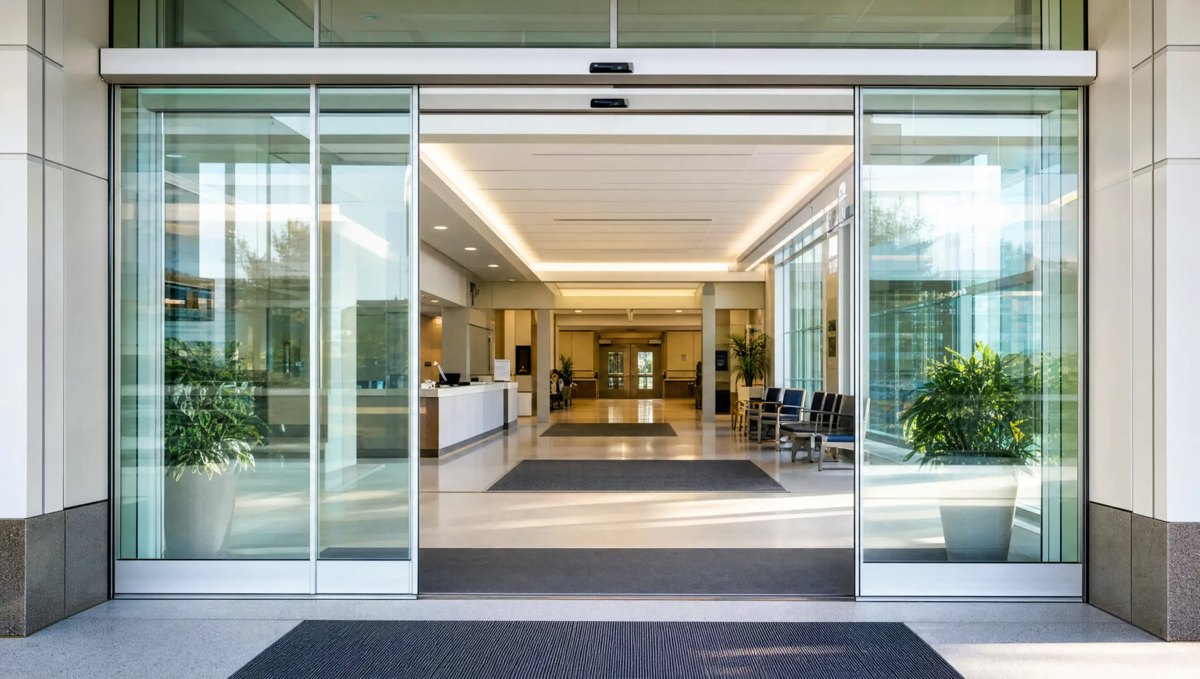
In a hospital or clinic, an automatic door is not a convenience. It is part of how you control infection, move patients, and stay compliant. A door that hesitates, sticks, or fails during a busy shift creates a real problem — for a gurney trying to get through, for a visitor with their hands full, and for the germs that spread every time someone has to grab a handle. At CSC Automatic Doors, we service healthcare facilities across central Arkansas, and we know the standard is higher here than almost anywhere else.
Touchless Hygiene Starts at the Door
Entry doors are one of the most-touched surfaces in any building. In a healthcare setting, that matters. Automatic doors — whether triggered by motion sensors, wave-to-open plates, or hands-free actuators — let staff, patients, and visitors pass through without touching anything. That reduces one common path of cross-contamination between waiting rooms, corridors, patient wings, and clean areas.
For hygiene to actually work, the sensors have to work. A wave plate that responds slowly, a motion sensor that misses a wheelchair, or a door that partially opens all push people back toward touching the surface. Keeping touchless entries genuinely touchless means keeping the operators and sensors properly adjusted and tested.
Uptime When Downtime Is Not an Option
A retail store can prop a broken door open until Monday. A hospital cannot. Emergency entrances, patient transfer routes, imaging suites, and pharmacy corridors all depend on doors that open every time, around the clock. When one fails, staff work around it — and workarounds slow care and create safety gaps.
The best defense is preventive maintenance. High-traffic healthcare doors cycle thousands of times a day, and that wear adds up on rollers, belts, motors, and sensors long before anything visibly breaks. Scheduled service catches worn parts early, so failures happen on a planned visit instead of in the middle of a night shift. We also keep common parts on hand so repairs move fast when something does go down.
Safety Inspections and Certified Service
Automatic doors in healthcare are held to strict safety standards, and they need regular inspection to meet them. Force, opening and closing speed, hold-open time, and sensor coverage all have to fall within safe limits — and those settings drift over time as parts wear.
This is not DIY territory. Adjusting door force, timing, operators, electrical components, or sensor fields is safety-critical work that should only be done by a certified AAADM technician. An improperly adjusted door can strike a patient or close on someone before they clear the threshold. Our technicians inspect to the applicable safety standards, document the results, and make adjustments correctly. If you are unsure when your doors were last inspected, that alone is a good reason to schedule one.
Accessibility for Every Patient
Healthcare facilities serve people who are injured, elderly, disabled, or moving with equipment. Accessible entrances are both a legal requirement and a basic part of patient care. That means doors that stay open long enough, open wide enough, and operate with the right force for someone using a wheelchair, walker, or crutches.
Push-plate actuators, correctly timed automatic operators, and clear approach paths all factor into a genuinely accessible entrance. During service, we verify these details so your entrances work for every patient and visitor — not just the ones in a hurry.
Built for High-Traffic Reliability
The difference between a door that lasts and one that constantly breaks often comes down to the right equipment for the traffic it sees. Main entrances, ER doors, and busy interior corridors need commercial-grade operators sized for heavy cycling — not lighter units that wear out fast. If your facility is fighting recurring problems with the same door, the real issue may be an undersized or aging operator, and we can assess whether repair or replacement makes more sense.
We serve hospitals, clinics, surgery centers, and medical offices throughout Little Rock, Conway, North Little Rock, Benton, Bryant, Searcy, Russellville, Cabot, and the surrounding communities. Commercial Service Company has served central Arkansas businesses since 1976, and that experience shows up in how carefully we treat facilities where reliability is not optional.
If your hospital or clinic needs automatic door service, inspection, or a maintenance plan built around healthcare uptime, call CSC Automatic Doors at 501-548-2374. We will take a look, tell you plainly where your doors stand, and keep them safe, compliant, and running.
Frequently asked questions
How often should hospital automatic doors be inspected?
Because healthcare doors cycle thousands of times a day and safety settings drift as parts wear, they should be inspected regularly by a certified AAADM technician. Many facilities pair inspections with a scheduled maintenance plan so wear is caught before it causes a failure. Call CSC at 501-548-2374 to set up a schedule.
Can our maintenance staff adjust the door's speed or force?
No. Adjusting opening force, timing, operators, electrical components, or sensors is safety-critical work that must be handled by a certified technician — an incorrectly set door can strike or close on a patient. Our AAADM technicians make these adjustments to the applicable safety standards and document the results.
Are touchless automatic doors better for infection control?
They help. Automatic and hands-free doors let people pass without touching a common surface, removing one path of cross-contamination between areas. The benefit only holds if the sensors and operators are properly maintained, so the door opens fully and reliably every time someone approaches.