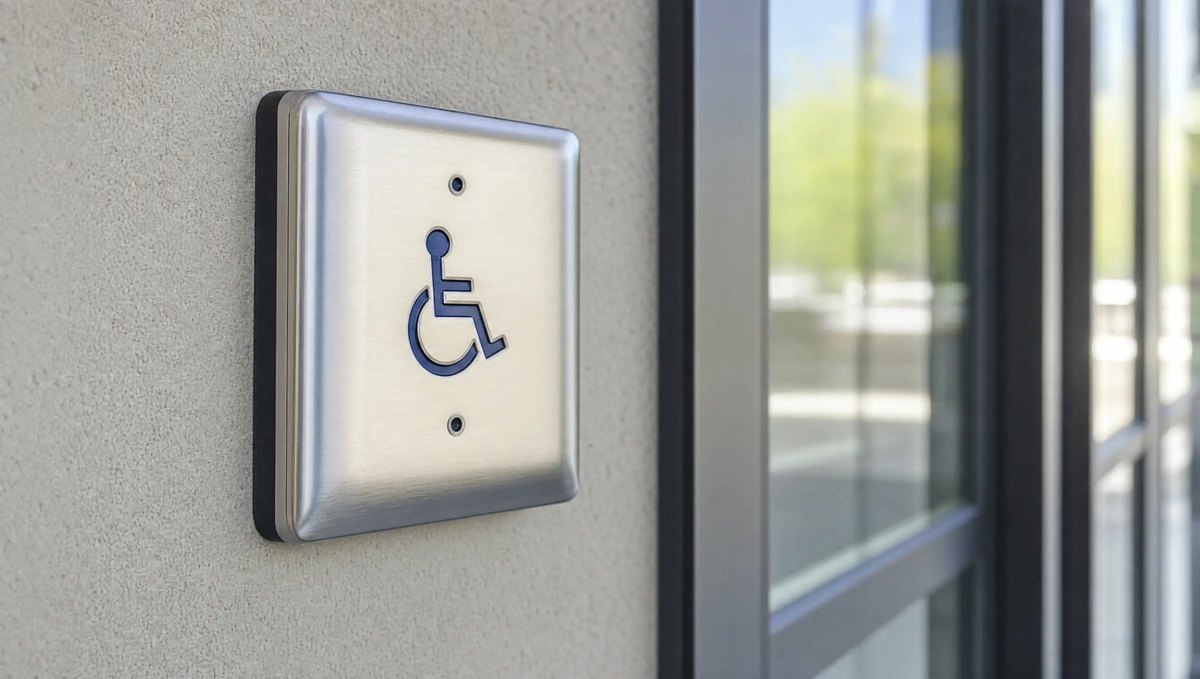
When a customer in a wheelchair rolls up to your entrance and presses the push-plate, they expect the door to swing open. When nothing happens, you have more than an inconvenience — you have an accessibility barrier at your front door, and for most commercial buildings that is not something to leave sitting. Handicap door buttons, or push-plate actuators, fail more often than people expect because they take heavy daily abuse and depend on a small chain of parts that all have to work together.
Here is what actually goes wrong, why it matters, and where the line sits between a quick check and work that belongs to a certified technician.
How an ADA Push-Plate Actually Works
A handicap actuator is not a light switch. When someone presses the plate, it sends a signal to the door operator — the motorized unit mounted above or beside the door. The operator then runs the door through its open cycle, holds it for a set time, and closes it under controlled force and speed. Everything downstream of that button press is set to specific limits for how fast, how hard, and how long the door moves.
That signal travels one of two ways. Hard-wired plates run a low-voltage wire from the button back to the operator. Wireless plates use a battery-powered transmitter in the plate that talks to a receiver wired into the operator. Knowing which type you have narrows the problem fast.
Why the Button Stops Working
Most dead push-plates trace back to a handful of causes:
- Dead transmitter battery. Wireless plates run on batteries that quietly die. This is the single most common reason a plate goes silent, and it often looks like a total failure.
- Damaged or loose wiring. Hard-wired plates take constant impact from hands, carts, and wheelchairs. Wires work loose, connections corrode, and conduit gets bumped out of place.
- Failed receiver or transmitter pairing. Wireless systems can lose their link after a power event or a component fault, so the plate sends a signal nothing is listening for.
- Worn or cracked plate switch. The switch behind the stainless face wears out after tens of thousands of presses.
- Operator fault. Sometimes the button is fine and the operator itself has faulted, lost power, or gone into a safety lockout.
What You Can Safely Check
A facility manager can safely confirm a few things before calling for service, and doing so helps your technician arrive prepared:
- Confirm the door has power and the operator is switched on, not set to manual or off.
- Note whether the plate is wired or wireless, and whether a battery cover is present.
- Check whether the door opens normally when triggered by its motion sensor — that tells you if the problem is the button or the operator.
- Look for obvious physical damage to the plate, its mount, or visible wiring.
That is where safe DIY ends. Do not open the operator, adjust force or timing, splice wiring, or attempt to re-pair a transmitter yourself.
Why the Rest Belongs to a Certified Technician
The operator controls how much force the door applies and how long it stays open. Those settings are safety-critical and regulated. Set the closing force too high and the door becomes a hazard to the exact people the button is meant to serve. This is why force, speed, timing, sensor, and operator work must be handled by an AAADM-certified technician who can test the door against the standard and document that it passes.
A certified technician will meter the wiring, test the transmitter and receiver, replace the plate switch or battery, confirm the operator responds correctly, and verify the full open-and-close cycle is compliant before leaving. That last step is the part a battery swap alone never covers.
Why It Matters While It's Down
A non-working handicap button is not a minor maintenance item. An accessible entrance only counts if it actually works. When the push-plate is dead, you have a barrier at your front door, and that exposes your business to complaints and liability — in healthcare, retail, and hospitality settings especially, where the public relies on that door every day. The longer it sits broken, the greater the exposure. Fixing it promptly protects your customers and your reputation.
Get It Working Again
If your ADA push-plate is dead, intermittent, or the door no longer responds the way it should, don't leave your accessible entrance out of service. The CSC Automatic Doors team has served central Arkansas businesses since 1976 and works on actuators, operators, and the full door system across Little Rock, Conway, Benton, and the surrounding area. Call us at 501-548-2374 and we'll get your accessible entrance back in compliance.
Frequently asked questions
What happens if a handicap door button stops working?
A non-functioning push-plate means your accessible entrance no longer works for the people who rely on it, which can expose your business to accessibility complaints and liability. It should be repaired promptly and verified compliant by a certified technician.
Can I just replace the battery in a wireless push-plate myself?
Swapping a transmitter battery is generally safe, and a dead battery is the most common cause of a silent wireless plate. But if the door still doesn't respond, the issue is likely wiring, pairing, or the operator — and that testing should be done by an AAADM-certified technician.
Why does the door not open even though the button seems fine?
The button press only sends a signal; the operator does the work. If the operator has lost power, faulted, or gone into a safety lockout, the door won't move even with a working plate. A technician can determine whether the fault is in the actuator or the operator.