Ask ten facility managers what an automatic door is and you get one answer. Ask a door technician and you get two. Low-energy and full-energy operators can look similar from the parking lot, but they move at different speeds, carry different guarding, and get serviced to different limits. Putting the wrong one on an opening is how a building ends up with an entrance that irritates customers, backs up traffic, or is simply not safe for the people walking through it.
What a Low-Energy Door Is Built to Do
A low-energy operator is a slow, gentle swing door. It opens under power when someone presses a wall plate or waves at a touchless switch, travels at a deliberate pace, holds open long enough for a person using a walker or carrying an armful of boxes to clear the opening, and closes just as slowly. The whole idea is that the door is gentle enough on its own that someone standing in the doorway is not going to get hurt by it.
That is why you see them on restroom corridors, break rooms, clinic exam wings, apartment lobbies and single-leaf storefronts — anywhere the goal is an easy, accessible entrance rather than moving a crowd. They also retrofit well onto an existing manual door and frame, which makes them the practical answer when a building needs an opening to work hands-free without tearing out the whole entrance.
What Changes with a Full-Energy Door
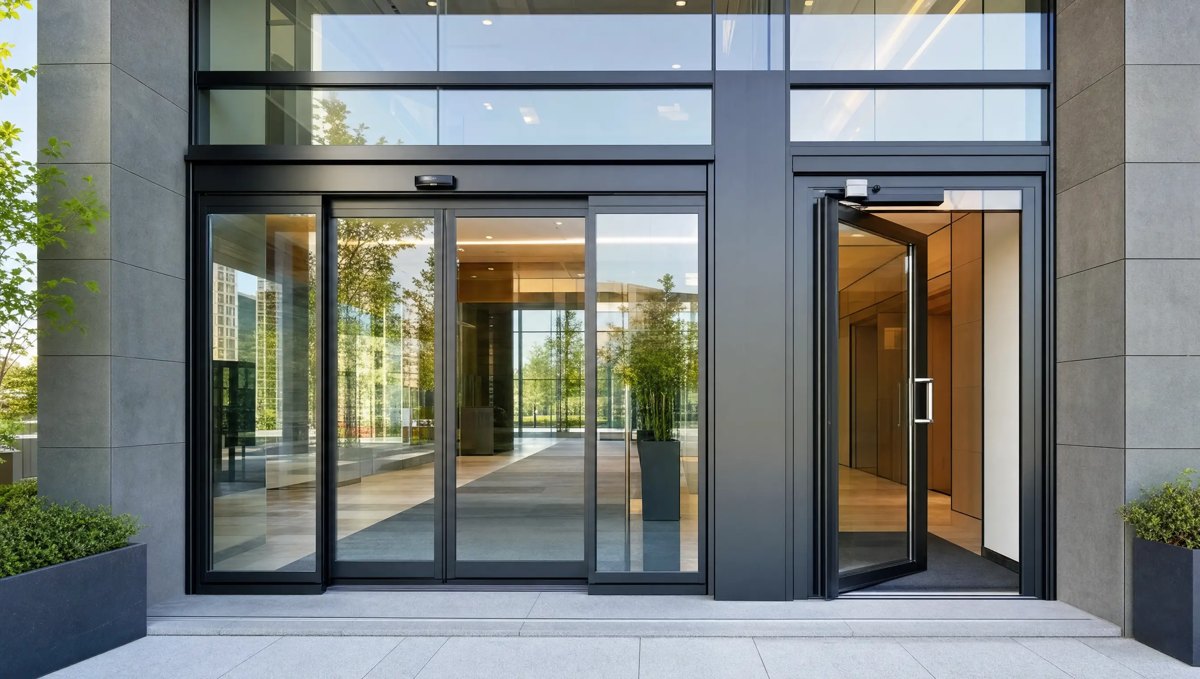
Full energy covers everything faster and heavier: the sliders at a grocery entrance, swing doors that open at full speed the moment someone approaches, a bank of entries handling steady two-way traffic all day. These operators move with real speed and real force. That is the point — they keep a line of shoppers or hospital traffic flowing — but it also means the door can no longer be treated as harmless to a person standing in its path. The protection has to come from somewhere else: from sensors and from physical guarding.
Guarding and Sensors: The Real Dividing Line
- Low energy: usually activated by a push plate or touchless switch, with force, speed and hold-open time set inside the manufacturer's limits. Some are paired with presence sensing, but the slow motion is doing most of the safety work.
- Full energy: needs layered sensing — approach detection to open the door, plus presence detection that keeps it open while somebody is still in the opening or the swing path. Dead spots in that coverage are not acceptable on a door moving at full speed.
- Full-energy swing doors also need physical guarding around the leading and hinge edges, along with guide rails and signage on the correct faces, so foot traffic is steered out of the arc instead of into it.
Every one of those items — force, speed, hold-open time, sensor pattern, breakout — is a safety-critical setting. They get measured and adjusted with proper testing equipment by an AAADM-certified technician, not with a screwdriver and a stopwatch. If a door is slamming, short-cycling, or closing on people, that is a service call, not a maintenance-closet fix.
Which Entrance Usually Calls for Which
- Main retail or grocery entrance with heavy two-way volume: full energy, usually sliding.
- Hospital or clinic main entrance with gurney and wheelchair traffic: full energy, with generous sensor coverage.
- Hotel lobby: full energy out front, low energy on the quieter interior doors.
- Restrooms, corridors, office suites, break rooms: low energy.
- An existing manual door that needs to become an accessible entrance: low-energy retrofit.
- Tight vestibules where a swing arc crosses the walking path: low energy, or a slider if the space allows.
How the Choice Changes Your Yearly Safety Inspection
Every automatic door on your property should get an annual safety inspection by a certified technician, whichever type it is. What differs is the checklist. On a low-energy door, the technician is mostly verifying motion: opening and closing force, opening and closing speed, hold-open time, the activation switch, and that the door stays gentle when someone blocks it.
On a full-energy door the inspection is longer, because more of the safety lives in parts that can fail quietly. The technician walks the sensor patterns looking for blind spots, confirms presence detection actually holds the door instead of just opening it, checks guide rails and guards, tests breakout, makes sure signage is intact and facing the right way, and reviews how the operator behaves during its own start-up checks. A dirty or misaimed sensor is a genuine hazard on a full-energy door and mostly a nuisance on a low-energy one. More parts and more traffic is also why busy full-energy entrances usually deserve attention between annual visits, not just once a year.
Not sure which type you have, or noticing an entrance that does not feel quite right anymore? Call CSC Automatic Doors at 501-548-2374 and we will come look at it. We have served central Arkansas businesses since 1976 — Conway, Little Rock, North Little Rock, Benton, Bryant, Maumelle, Jacksonville, Searcy, Russellville, Cabot, Sherwood and Hot Springs.
Frequently asked questions
Can a low-energy door be converted to full energy later?
Sometimes, but it is not a settings change. Full-energy operation needs the right operator, the sensor coverage and the physical guarding to go with it, and the opening itself has to have room for a fast-moving leaf. A technician should look at the door and the traffic pattern before anyone quotes a conversion.
Why does my automatic door seem slower than the one across the street?
It is very likely a low-energy operator and the one across the street is full energy. The slow, steady motion is intentional on a low-energy door, not a sign of a problem. If it has become slower than it used to be, or it stalls partway, that is worth a service call.
Who is allowed to adjust the speed or force on my automatic door?
An AAADM-certified technician with the right testing equipment. Speed, force, hold-open time and sensor aim are safety-critical settings kept inside the manufacturer's limits, so they are not a do-it-yourself adjustment. CSC can set and document them during service or your annual safety inspection.