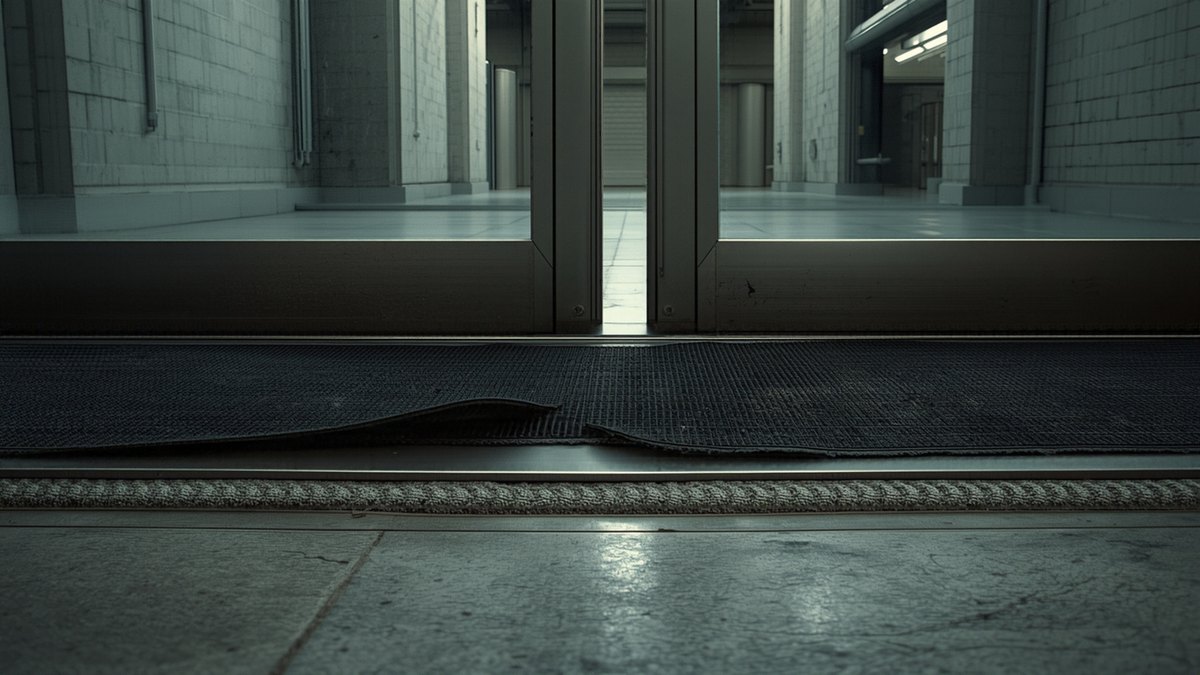
Entrance mats take a beating. They get walked on hundreds of times a day, rained on, mopped under, and occasionally run over by a cart or wheelchair. Over time they curl, shift, or wear thin — and when that happens right at an automatic entrance, the mat stops being a convenience and starts being a problem for the door. If your automatic door has started sticking, hesitating, or acting unpredictable, the issue might not be the operator at all. It might be the mat.
Curled and Creeping Mats Block the Slide Path
Sliding doors need a clear, level track to move along. A mat that has curled at the edges, bunched up from repeated foot traffic, or slowly crept out of position can sit high enough to catch the bottom of the door panel. Even a quarter-inch of lift is enough to cause the door to drag, stall mid-cycle, or bounce off the mat instead of closing fully. Over time, that extra resistance puts strain on the operator that it was never designed to handle.
- Check mats daily for curled corners, especially after mopping or power washing
- Watch for mats that have visibly shifted from their original position
- Replace mats once the backing starts to warp or the edges won't lie flat
Mats Sitting in the Sensor Zone
Automatic doors rely on sensors to know when someone is approaching and when it's safe to close. Those sensors are calibrated to read a specific zone in front of and around the doorway. A thick mat, a mat with a raised logo or pattern, or one that reflects light differently than the surrounding floor can confuse that reading. Some sensors are sensitive enough that a mat edge sitting in the wrong spot causes the door to stay open longer than it should, cycle open and shut repeatedly, or fail to detect someone standing in a blind spot. This kind of adjustment is a safety-critical setting, and it's not something to guess at — if you suspect a mat is interfering with sensor coverage, that call belongs to a certified AAADM technician with the right testing equipment to check and recalibrate the zone properly.
Trip Hazards at the Threshold
Thresholds for automatic doors are usually built with accessible entrances in mind — a flush, low-profile transition for carts, wheelchairs, strollers, and foot traffic moving quickly in and out. A mat with a thick pile, a loose edge, or one that's simply too big for the space can turn that smooth transition into a lip someone catches a toe on. This is especially risky right at the threshold itself, where people are often looking ahead at the opening door rather than down at their feet. A mat that bunches up right where the interior and exterior flooring meet is one of the most common and most overlooked fall risks at a business entrance.
Choosing Matting That Suits a Powered Entrance
Not every mat is built for an automatic door. The right choice depends on the traffic level, the weather exposure, and the clearance your door and operator need.
- Low-profile, flat-weave mats generally sit closer to the floor and are less likely to interfere with door clearance
- Beveled or tapered edges reduce the chance of a catch point at the threshold
- Non-slip, securely anchored backing keeps the mat from creeping toward the sensor zone or slide path over time
- Mats sized to fit the vestibule or entry area, rather than oversized mats that extend into the door's path, keep the full swing or slide clear
If you're not sure whether your current matting is a good fit for your specific door system, that's worth a conversation before you replace it — the clearance needed for a sliding door is different from what a swinging or revolving door needs.
When to Call a Technician
Swapping out a worn or curled mat is something your staff can usually handle. But if the door is already catching, hesitating, or behaving oddly even with a good mat in place, that points to a deeper issue with sensor calibration, alignment, or the operator itself — and that work belongs to a certified technician, not a trial-and-error fix on site.
If your entrance doors have been acting up and you're not sure whether it's the mat, the sensors, or something else, give CSC Automatic Doors a call at 501-548-2374. We serve Little Rock, Conway, North Little Rock, Benton, Bryant, Maumelle, Jacksonville, Searcy, Russellville, Cabot, Sherwood, and Hot Springs, and we're happy to take a look and tell you straight what's going on.
Frequently asked questions
Can a dirty or wet mat really cause an automatic door to malfunction?
Yes. A soaked or heavily soiled mat can swell, curl, or shift out of place, any of which can interfere with the door's slide path or sensor zone. Keeping mats clean and dry reduces this risk significantly.
How do I know if my mat is the problem versus the door itself?
Try removing the mat temporarily and see if the issue goes away. If the door operates smoothly without it, the mat is likely the cause. If problems continue, it's time to have a certified technician inspect the system.
How often should entrance mats be replaced at a busy commercial entrance?
It depends on foot traffic and weather exposure, but any mat that has started to curl, bunch, or lose its flat shape should be replaced right away, since those changes are what create door and trip hazards.