
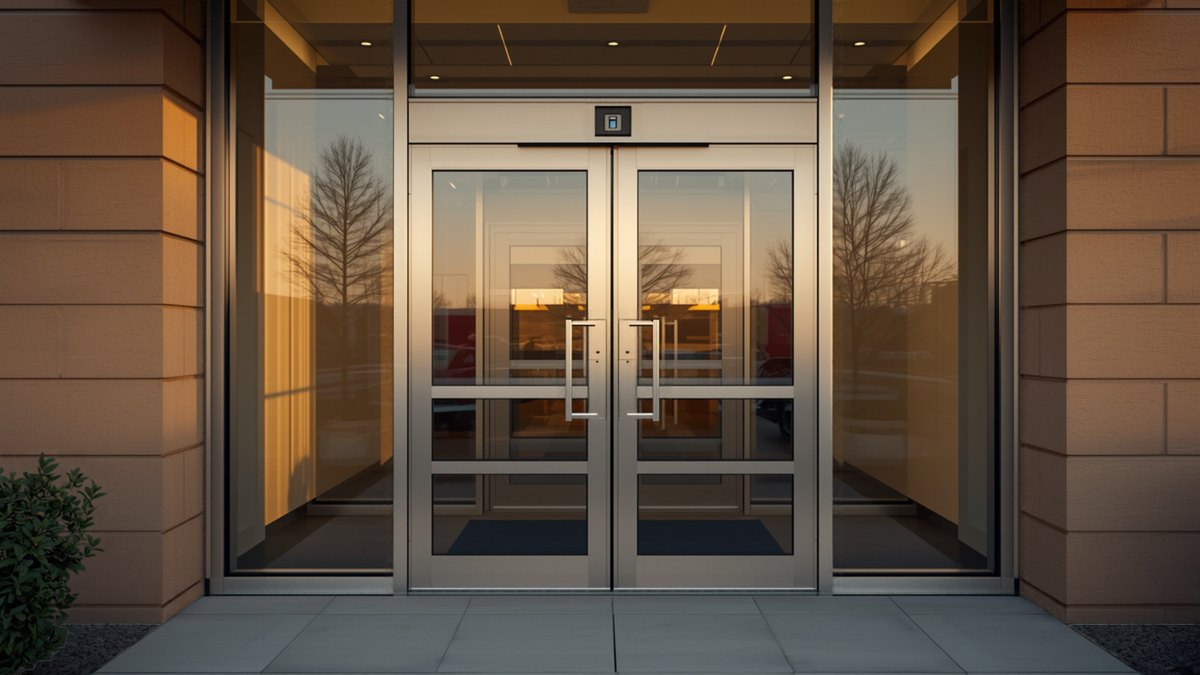
A daycare or childcare center front entrance has a job that most commercial lobbies don't: keep small children inside while letting staff, parents, and visitors move through easily. A standard automatic door that swings or slides open for anyone standing nearby isn't built for that job. If you operate a childcare facility in Conway, Little Rock, Benton, Bryant, Maumelle, Jacksonville, Searcy, Russellville, Cabot, Sherwood, or Hot Springs, here's what to think through before an automatic entrance goes in or gets upgraded.
Why a Daycare Entrance Needs More Than a Standard Automatic Door
Most commercial automatic doors are built around convenience — walk up, the door opens, you walk through. In a retail store or office lobby, that's exactly right. In a childcare center, a door that opens for anyone who approaches it, including a four-year-old who wandered away from a classroom, is a problem. The entrance needs to tell the difference between an approved adult and a curious toddler, and a motion-activated automatic operator can't make that distinction on its own.
Buzzer and Intercom Release Instead of Free-Swinging Automatic Operation
Instead of a door that opens automatically whenever someone steps into its sensor field, most childcare entrances are set up with a buzzer or intercom release. Staff at the front desk see or hear who's at the door, then trigger the release remotely. The door operator still does the physical work of swinging or sliding the door open and closed smoothly, but the decision to open it sits with a staff member, not a motion sensor.
- Front desk staff can screen visitors before granting entry
- Parents and guardians can be buzzed in quickly without staff leaving their post
- The door won't open on its own just because a child is standing near it
This kind of access control integration is electrical and safety-critical work. Tying a buzzer or intercom system into an automatic door operator should be handled by a certified AAADM technician who can confirm the release wiring and the door's safety sensors work together correctly.
Slower, Gentler Hold-Open and Closing Speeds Around Small Children
Small children move differently than adults — they stop short, double back, or linger in a doorway. The opening speed, hold-open time, and closing speed on a daycare door should be set with that in mind, generally slower and gentler than you'd use on a retail entrance where adults move through briskly. A longer hold-open gives a parent carrying a car seat or towing two kids enough time to clear the opening, and a gentler closing speed reduces the force behind the door if a child pauses underneath it.
These are precise, safety-critical settings on the door operator, not something to guess at or adjust with a screwdriver. A certified AAADM technician uses testing equipment to set opening and closing speed and force within the manufacturer's limits for your specific door and traffic pattern.
Mounting Actuators Where Staff Can Reach Them, Not Toddlers
If your entrance also has a push-plate actuator for visitors who use wheelchairs or have their hands full, where you mount it matters as much as how it's wired. The actuator needs to sit at a height and location that staff and accessible-entrance visitors can reach from a natural standing or seated position, but it should not be low enough or exposed enough for a toddler to reach up and press on their way past. Many daycare centers mount the primary release control behind the front desk or in a staff-only location, with any publicly accessible actuator positioned and, where appropriate, recessed or shielded so it's not an open invitation for small hands.
Programming That Keeps Kids In While Keeping Staff and Parents Moving
The real goal is a door that's an obstacle to an unsupervised three-year-old but barely noticeable friction for staff and parents. That balance comes from how the operator and access controls are programmed together: the buzzer release tied to a specific trigger rather than general motion, exit delays or staff-only override switches for pickup and drop-off rushes, and hold-open timing tuned so the door doesn't sit open longer than it needs to during busy arrival windows. Getting that programming right takes a technician who understands both the door hardware and how your front desk actually operates day to day.
CSC Automatic Doors has been part of Commercial Service Company since 1976, serving businesses across central Arkansas with automatic entrance installation, service, and AAADM-certified adjustments. If you're planning a new daycare entrance or want an existing automatic door reviewed for how it handles small children, call us at 501-514-4932.
Frequently asked questions
Should a daycare's front door open automatically whenever someone walks up to it?
Generally no. Most childcare centers tie the automatic door into a buzzer or intercom release so staff control who gets in, rather than letting a motion sensor open the door for anyone nearby, including a child.
How much slower should the door close around toddlers compared to a regular commercial entrance?
There's no single number that fits every door — the right opening and closing speed depends on the operator, the door size, and your layout. A certified AAADM technician measures and sets those speeds within the manufacturer's limits for your specific entrance.
Will a buzzer-controlled door slow parents down at pickup and drop-off?
Not when it's programmed well. Staff can release the door quickly from the front desk, and the system can be set up so busy arrival and pickup windows don't create a bottleneck, while still keeping an unsupervised child from walking out on their own.