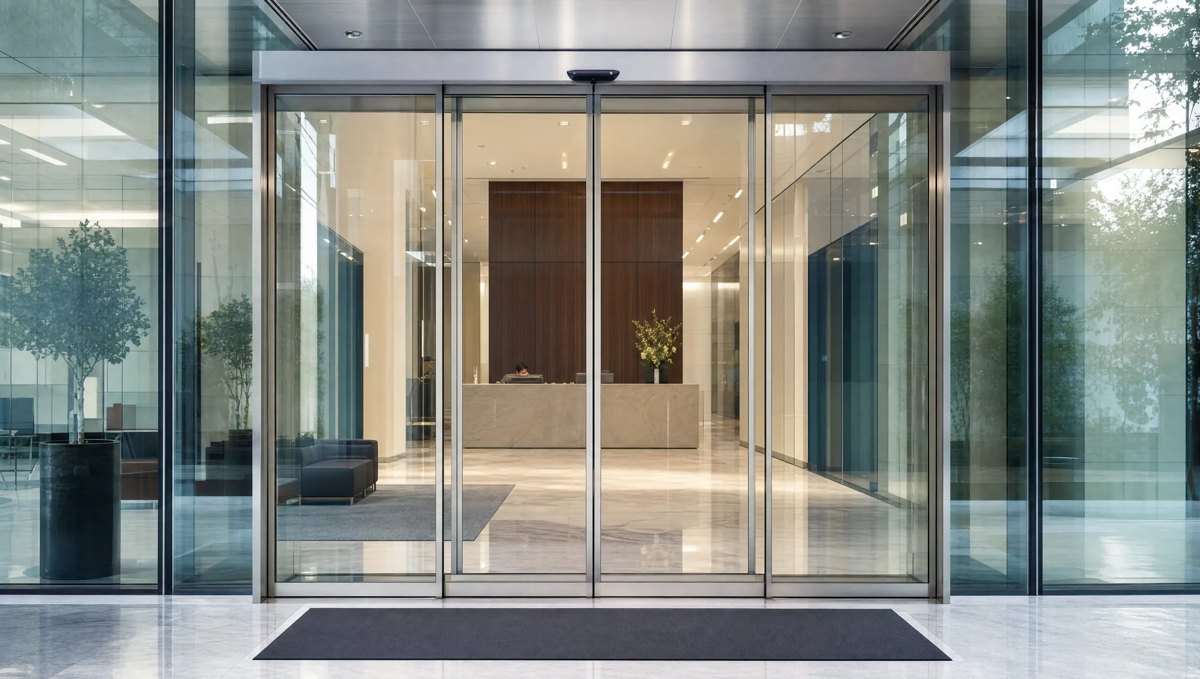
More facilities in Little Rock, Conway, and the surrounding area are pairing badge or fob readers with their automatic entrances — you tap a card, and the door is supposed to just work. In practice, getting a card reader to talk to an automatic door operator means coordinating two systems that were built by two different industries. Here's what's actually happening behind that badge tap, and why it pays to get the handoff right the first time.
What Happens When a Badge Hits the Reader
A card or fob reader by itself doesn't move a door. It reads a credential and passes that information to an access control panel, which decides whether the credential is valid. If it is, the panel closes a relay — essentially a dry contact — that's wired into the automatic door operator's control board. That relay closes the same circuit an operator normally uses for a push plate or a motion sensor. From the operator's point of view, a valid badge tap looks the same as someone pressing a wall-mounted button: it's simply told to run its open cycle.
Unlocking Is Not the Same as Opening
This is where a lot of confusion happens. On many commercial entrances, the automatic operator and the electric lock or strike are separate pieces of hardware, wired and powered independently. A valid badge read may only release the lock — it doesn't automatically mean the operator will swing or slide the door open. For the two to work together smoothly, the access panel typically needs to release the lock first, then trigger the operator a moment later once the door is actually free to move. Skip that sequencing and you get doors that unlock but still require a push, or worse, an operator trying to move a door that's still latched. Getting that timing set correctly is a job for whoever is programming the access panel working hand in hand with the technician who understands the operator's cycle.
Fail-Safe or Fail-Secure? Know the Difference
Every electrified lock used on an automatic door is set up one of two ways. Fail-safe hardware releases and leaves the door unlocked if it loses power. Fail-secure hardware does the opposite — it stays locked even without power, and only unlocks when it's actively signaled to. Neither one is universally "correct." The right choice depends on which side of the building the door is on, whether it sits on a path people need to get out of during a power outage, and how the rest of the facility's security and life-safety plan is designed. This isn't a setting to guess at after the hardware is already installed — it should be decided up front by the security vendor and the door contractor together, and any changes to how a lock is configured belong to a certified technician who understands both the electrical side and the manufacturer's limits for that hardware.
Why the Door Contractor and Security Vendor Need to Talk
A card reader integration almost always involves two separate companies. Your security vendor supplies and programs the reader, the access panel, and the credentials. Your automatic door contractor owns the operator, the safety sensors, and often the locking hardware itself. When these two groups install their pieces without comparing notes, problems show up fast — a relay that outputs the wrong voltage for the operator's control board, a locking sequence that fights the door's open cycle, or a reader that's wired in without accounting for the operator's own safety sensors. The fix is simple and inexpensive compared to troubleshooting it later: one planning conversation before anyone starts pulling wire, with both vendors looking at the same wiring diagram and agreeing on which system controls what.
Bringing In the Right Technician
Whether you're adding a reader to an automatic door that's already installed or planning both from scratch, the operator side of the job — relay wiring, timing adjustments, force settings, and lock configuration — should go through an AAADM-certified technician with the testing equipment to confirm the door is behaving the way it's supposed to once the reader is tied in. CSC Automatic Doors has been serving businesses across central Arkansas since 1976, and we regularly coordinate directly with security vendors on projects like this so nobody is left guessing about who owns which part of the system.
If you're planning a card reader integration for an automatic entrance, or you've got one already installed that isn't behaving the way it should, call CSC Automatic Doors at 501-548-2374 and we'll help you sort out the details with your security vendor.
Frequently asked questions
Can any card reader be wired into any automatic door operator?
Most access control panels can be wired into most commercial operators because they both use simple relay-based inputs, but the voltage, wiring type, and timing settings still need to match. That's why the security vendor and the door contractor should compare notes before installation instead of wiring things independently.
If the power goes out, will the door be locked or unlocked?
It depends on how the lock hardware is configured — fail-safe hardware unlocks when power is lost, and fail-secure hardware stays locked. That decision is made based on the door's location and role in the building, and it should be set up intentionally by your security vendor and door contractor, not left to chance.
Who should we call first — the door company or the security vendor?
Either one, as long as they end up talking to each other before installation. Loop in both your automatic door contractor and your security/access control vendor early so the reader, the lock, and the operator are all set up to work together from day one.