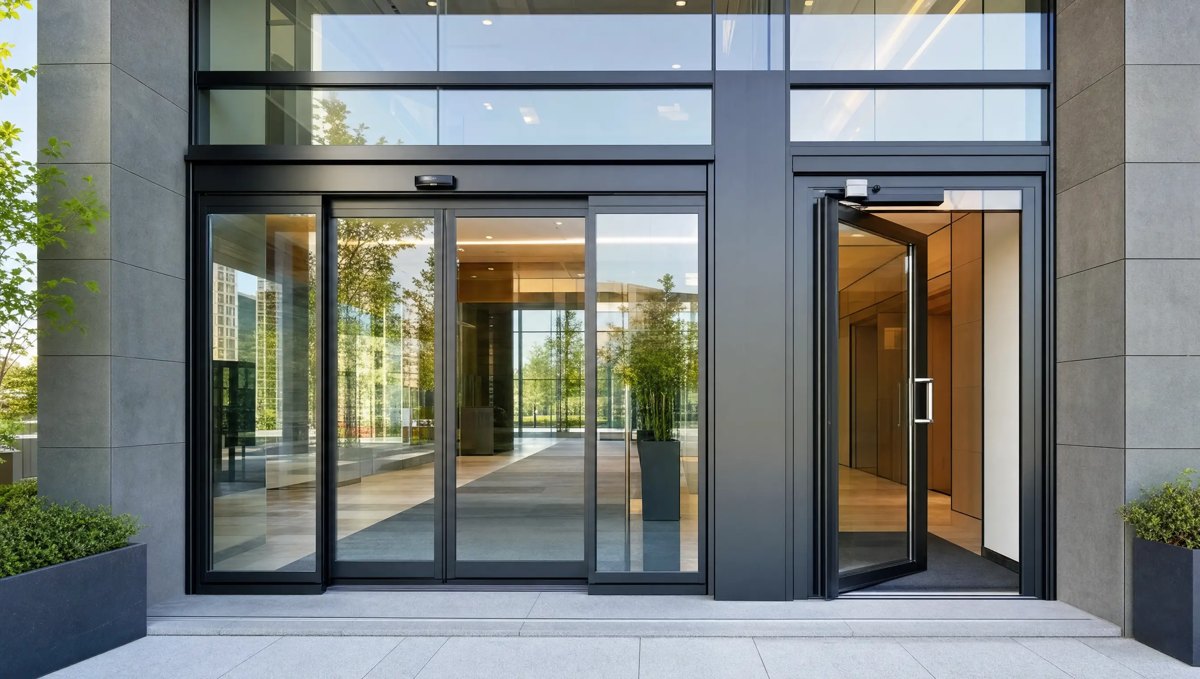
Two Ways to Slide Open
Most commercial sliding entrances come down to two layouts: a single slide door, where one panel (sometimes two panels moving together) travels in one direction, and a bi-parting door, where two panels split apart from the center and retract into pockets on either side. Both use the same basic sliding operator technology. The difference is in the opening itself, and that difference affects everything from how wide your building needs to be at that wall to how much that opening costs to keep running.
Wall Space: The First Real Constraint
A single slide door needs one full pocket of wall space to stack its panel (or panels) out of the way. A bi-parting door needs two pockets, one on each side, because each panel retracts toward its own wall. If your entrance sits in a tight storefront, between two interior walls, or next to a vestibule corner, that pocket space may simply not exist on both sides. In those cases a single slide door is often the only layout that physically fits. Wider lobbies, mall entrances, and healthcare entries usually have the wall real estate for bi-parting and gain a wider clear opening as a result.
Traffic Direction and Flow
Single slide doors tend to work best where traffic moves mostly in one predictable direction, like a retail entrance where customers enter center and exit the same opening but the flow is light to moderate. Bi-parting doors shine where two-way traffic is heavy and constant, because the opening splits evenly and gives people on both sides a visual cue to move toward the center rather than crowding one edge. Facility managers dealing with two-way foot traffic, delivery carts coming one way and customers going the other, usually find bi-parting reduces the bottleneck.
Cart, Wheelchair, and Stretcher Width
Clear opening width is where the two layouts really separate. A single slide door's clear opening is limited by how far one panel (or a pair moving together) can travel, and travel distance is capped by available wall pocket. A bi-parting door gets its clear width from two panels splitting the distance, so for the same overall door width, bi-parting typically delivers a wider usable opening. That matters for grocery carts, pallet jacks, wheelchairs, and especially stretchers and gurneys in healthcare settings, where the door needs to clear a wide bed plus the people walking alongside it. If your traffic includes wide equipment on a regular basis, measure the actual equipment width first and work backward to the opening you need.
Appearance and First Impressions
Single slide doors read as simpler and more compact, which suits smaller storefronts, offices, and restaurants where a modest entrance fits the brand. Bi-parting doors have a more formal, symmetrical look that reads as higher-traffic and higher-capacity, which is why you see them at hospital entrances, airports, and larger retail anchors. Neither look is objectively better; it's about matching the entrance to the scale and tone of the building.
Opening Speed
Because a bi-parting door's two panels travel the opening distance together instead of one panel covering it alone, a bi-parting door often reaches full clear width faster than a single slide door of the same overall size. For high-traffic entries where people are arriving close together, that faster full-open cycle can keep lines moving and reduce the chance of someone walking into a still-opening panel. The exact timing and speed settings on any automatic door are safety-critical and should only be set or adjusted by a certified AAADM technician using the manufacturer's testing equipment, never adjusted in the field by staff.
Maintenance Load Over Time
More moving parts generally means more to maintain. A bi-parting door has two carriers, two belts or tracks, and two sets of rollers doing the work that a single slide door does with one. That doesn't make bi-parting unreliable, but it does mean routine inspections have twice the hardware to check, and a wear issue on one side can eventually show up as uneven panel movement if it's not caught early. Single slide doors, with fewer moving components, are generally simpler to inspect and tend to have a lighter day-to-day maintenance load. Either way, a regular inspection schedule with a trained technician catches wear before it turns into a breakdown or an unsafe opening.
Which One Fits Your Building?
There's no universal right answer, but a few questions usually point the way:
- Do you have wall pocket space on both sides of the opening, or only one?
- Is your traffic mostly one direction, or heavy and two-way?
- Does your equipment, carts, wheelchairs, or stretchers, need a wide clear path?
- Does the entrance need to project a higher-capacity, formal entrance, or a simpler storefront feel?
- Can your facility support the maintenance attention a bi-parting door's extra hardware calls for?
Walking through those with an eye on your actual building, not just a catalog photo, is the fastest way to land on the right layout.
CSC Automatic Doors has been helping central Arkansas businesses in Little Rock, Conway, North Little Rock, Benton, Bryant, Maumelle, Jacksonville, Searcy, Russellville, Cabot, Sherwood, and Hot Springs choose, install, and maintain the right entrance since 1976. If you're weighing bi-parting against single slide for your building, call 501-548-2374 and we'll walk the space with you.
Frequently asked questions
Can a single slide door be converted to a bi-parting door later?
Usually not without replacing the header, track, and operator, since a bi-parting setup needs a different frame and two panel carriers instead of one. If there's a chance you'll need wider clear openings down the road, it's worth planning for that during the initial install rather than retrofitting later.
Which layout is better for a healthcare entrance with stretcher traffic?
Bi-parting doors are the more common choice for entrances that regularly handle stretchers, gurneys, or wide wheeled equipment, since splitting the opening across two panels generally yields a wider clear path than a single slide door of the same overall width. The right width for your specific equipment should be confirmed against actual measurements, not just the general layout.
Do bi-parting doors need more maintenance than single slide doors?
Bi-parting doors have two sets of panels, tracks, and rollers instead of one, so there's more hardware for a technician to inspect during routine service. That doesn't mean they break down more often, just that the maintenance checklist covers more components. A regular inspection schedule with a certified AAADM technician keeps either layout running reliably.