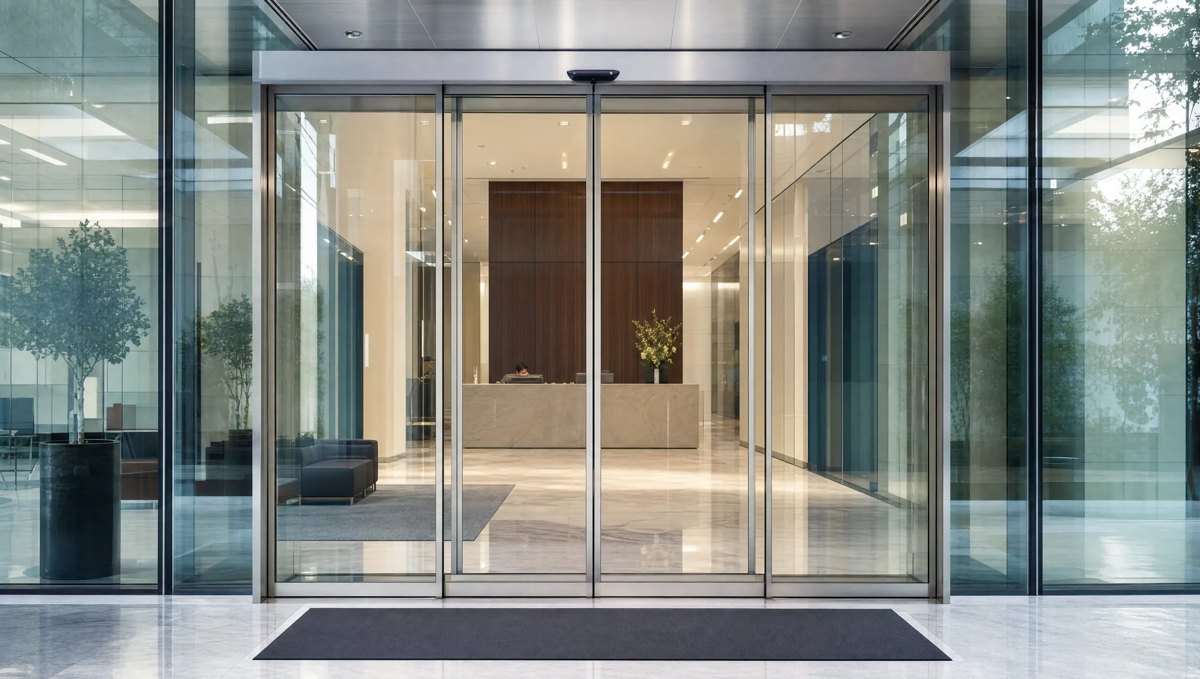
An office building or a bank branch sells confidence, and the automatic entrance is the last thing a client touches before reaching your front desk. When it opens cleanly and quietly, nobody thinks about it. When it hesitates, drags, or needs a shove, it is the first flaw anyone sees. For property managers and branch managers across central Arkansas, the entrance is not just hardware. It is part of the presentation.
A Professional First Impression Starts at the Threshold
Office and bank entrances carry a different kind of traffic than a grocery store. Fewer cycles per day, but the people coming through are often carrying briefcases, laptop bags, deposit bags, or a tray of coffee for a meeting. A door that opens too slowly makes them wait. A door that opens too fast startles them. A door with smudged glass and a scuffed threshold undercuts a lobby you spent real money on.
Appearance earns a standing item on the janitorial list: glass and frames cleaned daily, push plates wiped down, thresholds kept free of the grit that grinds into the track.
After-Hours Locking and Security Integration
This is where office and bank doors get genuinely complicated. Most of these entrances are not just doors. They are part of a security system, and they have to do several jobs at once:
- Lock securely at close of business and unlock on a set schedule in the morning
- Interface with card readers, keypads, or fob systems for staff entry outside business hours
- Release on the fire alarm so the building can be evacuated, per code
- Allow free egress from the inside at all times, even when locked from the outside
- Switch between full automatic, exit-only, and locked modes without anyone rewiring anything
When one of those functions drifts, it fails expensively in both directions. A door that will not lock leaves the building open overnight. A door that locks too well can block an exit, which is a life-safety and code problem. Locking hardware, electric strikes, access control wiring, and alarm interfaces are work for a certified technician, not for maintenance staff with a screwdriver. A drifting unlock schedule, an intermittent card reader, or a door that does not lock consistently at night is a service call.
Lobby Comfort Is a Door Problem
Every complaint about a cold lobby in January or a humid one in July eventually traces back to how long the front door stands open and how well it seals when closed. On an automatic entrance, hold-open time, opening and closing speed, and the condition of the weather seals all decide how much conditioned air walks out the door. Worn brush seals, a gap at the meeting stile, or a door timed to stay open longer than it needs to will quietly run up an HVAC bill and make the front desk miserable.
The tempting fix is to shorten the hold-open time yourself. Do not. Timing and force are safety settings governed by industry standards, and they control whether the door can close on someone still in the opening. Those adjustments belong to an AAADM-certified technician with the right test equipment.
Service Scheduled Around Your Business, Not Through It
The advantage an office or bank has over a hospital or a hotel is a predictable schedule. Your building has real off-hours, and there is no reason for door service to happen in the middle of them. Preventive maintenance, annual AAADM safety inspections, sensor checks, and most repairs can be booked early in the morning, after close, or on a weekend, so the lobby is quiet and no customer ever sees a technician on a ladder.
That is the argument for a maintenance program instead of a repair list. Regular service catches worn rollers, dry tracks, aging belts, drifting sensors, and failing seals while they are still small, at a time you chose. Waiting until the door fails means an emergency call during business hours with a client watching it happen, and for a bank branch, an entrance that cannot be secured at closing.
What to Watch For Between Service Visits
Your staff sees the door hundreds of times a week. Ask them to report:
- Grinding, squealing, or scraping during opening or closing
- The door hesitating, stopping partway, or reversing for no reason
- Anyone having to wave, step back, or wait to trigger the sensors
- Failing to lock at close, or not unlocking on schedule in the morning
- Noticeable drafts at the entrance, or a gap where the doors meet
- A safety decal that is faded, peeling, or missing
Report them. Do not adjust them. Sensors, operators, force and timing settings, and electrical connections are safety-critical and require a certified technician.
CSC Automatic Doors has served central Arkansas businesses since 1976, with AAADM-certified service for office buildings and bank branches in Conway, Little Rock, North Little Rock, Benton, Bryant, Maumelle, Jacksonville, Sherwood, Cabot, Searcy, Russellville, and Hot Springs. If your entrance needs repair, an annual inspection, or a maintenance program scheduled outside business hours, call us at 501-548-2374 and we will work around your day.
Frequently asked questions
Can our automatic entrance be locked and unlocked on a schedule?
Yes. Most commercial automatic doors can be set to unlock at opening time and lock at close, and many integrate with card readers or keypads for staff entry after hours. The locking hardware, access control wiring, and fire alarm interface all have to work together and meet egress code, so setup and adjustment should be done by a certified technician.
Our lobby is drafty in winter. Is that the automatic door's fault?
Often, partly. Worn weather seals, a gap where the doors meet, or a hold-open time longer than it needs to be all let conditioned air escape. A technician can replace seals and adjust timing within the safe ranges set by industry standards. Never shorten hold-open time yourself, because those settings control whether the door can close on someone.
Can automatic door service be done outside our business hours?
Yes, and for offices and banks it usually should be. Preventive maintenance, annual AAADM safety inspections, and most repairs can be scheduled early morning, after close, or on weekends so your lobby stays quiet. Call CSC at 501-548-2374 to set a service window that fits your building's schedule.