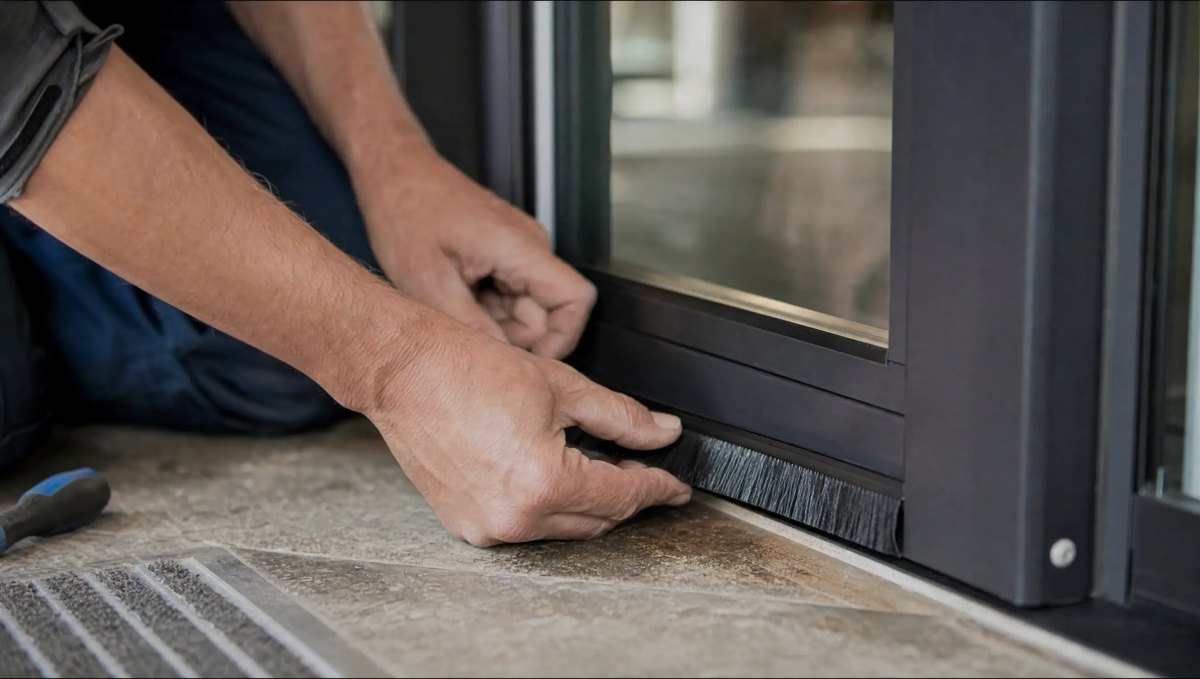
Nobody calls us about a weather seal. They call about a cold lobby, a power bill that keeps creeping up, a wasp problem at the front door, or a wet spot on the floor every time it rains sideways. More often than you would think, the answer is a strip of brush or rubber on the bottom of the door that quietly quit doing its job a year and a half ago.
What "Weather Seals" Actually Means on an Automatic Door
An automatic entrance is not one seal. It is a set of them, and each one closes a different gap:
- Bottom sweeps — the brush or blade along the bottom edge of a sliding or swinging panel, riding just above the floor track or threshold.
- Pile or brush weatherstripping — the fuzzy strip in the jamb and header channels.
- Meeting-stile seals — where two bi-parting sliding panels come together in the middle.
- Perimeter gaskets and glazing seals — the rubber around the frame and the glass.
- Thresholds and floor track covers — the metal at the floor the sweep has to seal against.
Every one of those is a consumable. They are built to wear out so the expensive hardware does not.
They Wear Invisibly, Which Is the Whole Problem
A broken operator announces itself. A seal does not. Brush filaments do not snap; they lie down. After enough cycles they take a permanent set and stop springing back against the panel, so the strip still looks full from three feet away while passing daylight underneath. Rubber gaskets fail differently — Arkansas sun and heat cook them until they harden, shrink at the corners, and stop compressing.
High-traffic entrances get there faster. So do doors that take cart and pallet-jack hits at the bottom rail, doors on the weather side of the building, and any entrance where salt, grit, and mop water sit in the track all winter. Retail and grocery see it first; clinics, hotels, banks, and office lobbies get there on a slower clock.
What a Failed Seal Actually Costs
- Conditioned air, all day. A closed door with a gap is an opening your HVAC fights around the clock — not just during the seconds someone walks through. In an Arkansas August, that is the most expensive air in the building walking out the front.
- Pests. A quarter-inch gap under a door is an open invitation for roaches, ants, wasps, and mice. For restaurants and food retail, that is a health-inspection problem, not just a nuisance.
- Water and grit. Blowing rain crosses a bad threshold onto your entry floor, which is a slip claim waiting to happen. Debris rides in behind it and ends up in the track, grinding on rollers.
- Comfort. Cashiers, front-desk staff, and greeters work in the draft. That is the one you hear about.
A Five-Minute Check You Can Do Yourself
This part is safe for anyone on your staff, because it involves looking, not adjusting:
- Stand inside with the door closed. Any daylight around the frame, under the panels, or between bi-parting panels is a gap.
- Run the back of your hand along the bottom edge and the meeting stile. You should not feel moving air.
- Look at the brush itself. Flattened, matted, missing chunks, or gray and brittle means it is done.
- Check the threshold and track for standing water, grit, or salt after a storm.
- Look for a dirt line on the floor just inside the door. That streak shows where the air comes in.
Replace the Seal, Leave the Door Alone
Here is the line we will not blur. Swapping worn weatherstripping is straightforward maintenance work. But the reason a seal failed often sits in the hardware around it — a panel out of alignment, a worn roller letting the door hang low, a sagging swing door, a shifted threshold. Correcting that means touching alignment, closing force, and door timing, which are safety-critical settings. Force and speed adjustments, operator work, electrical, and sensor setup belong to an AAADM-certified technician with proper testing equipment. Do not let a handyman shim, bend, or re-tension an automatic door to close a gap — you can turn an energy problem into a liability problem in an afternoon.
Seals Get Checked on Every PM Visit
Because seals fail quietly, we do not wait for you to notice. Weatherstripping, sweeps, thresholds, and gaskets are on the checklist for every preventive maintenance visit, right alongside safety and force testing. The technician documents what is worn, replaces what needs it, and tells you what to watch before the next visit. It is usually the cheapest line on the ticket and the fastest to pay for itself.
Commercial Service Company has kept central Arkansas businesses running since 1976, and our automatic door division serves Conway, Little Rock, North Little Rock, Benton, Bryant, Maumelle, Jacksonville, Sherwood, Cabot, Searcy, Russellville, and Hot Springs. If your entrance is drafty, leaking daylight, or letting in more than customers, call CSC Automatic Doors at 501-548-2374 and we will get a technician out to look at it.
Frequently asked questions
How often do automatic door weather seals need to be replaced?
There is no fixed interval, because it depends on cycle count, exposure, and abuse. A high-traffic retail or grocery entrance on the weather side of the building will wear sweeps and brush seals far faster than a quiet office lobby. That is why we inspect seals on every preventive maintenance visit and replace them based on actual condition rather than a calendar.
Can I replace the brush sweep on my automatic door myself?
Replacing a sweep sounds simple, but on an automatic door it usually is not a standalone job. The seal wore out for a reason, and the fix often involves panel alignment, roller condition, or threshold height. Those affect closing force and timing, which are safety-critical settings that belong to an AAADM-certified technician. Call it in rather than shimming or bending anything yourself.
Will new weather seals actually lower my energy bill?
Sealing a real gap stops conditioned air from leaving the building around the clock, not just when the door opens, so it helps. We will not put a dollar figure on it, because the savings depend on your gap size, your HVAC system, and your rates. What we can tell you is that seal replacement is one of the least expensive repairs on an automatic entrance, and it also keeps water, grit, and pests out.