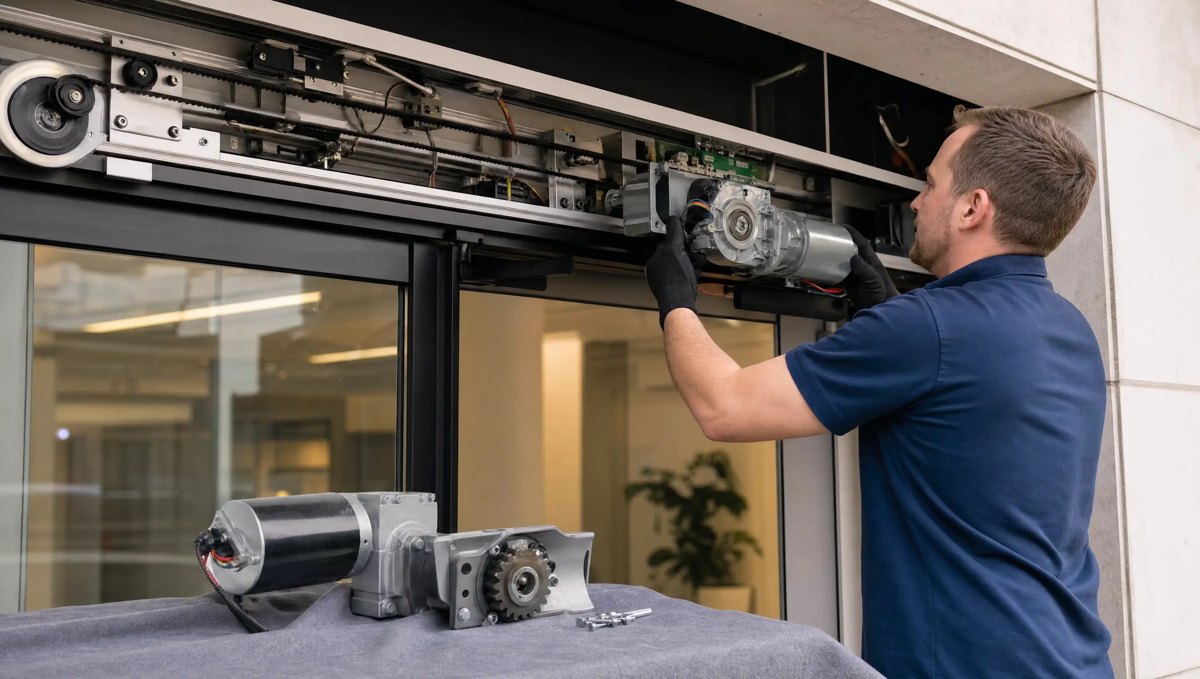
Why Automatic Door Parts Go Obsolete
Automatic door operators are built by a handful of manufacturers, and like any equipment with electronics inside, model lines get discontinued. A control board or motor that was standard equipment when your doors were installed can be phased out years later, even while the door itself still works fine. If your building has had the same automatic entrance since the 1990s or early 2000s, there's a real chance the operator underneath the header is no longer in production.
The First Sign: A Board or Motor That's No Longer Made
Most facility managers find out the hard way — a service call turns up a failed control board, and the technician has to check whether a direct replacement even exists. Older operators sometimes used proprietary boards tied to a specific manufacturer's product line. When that line is discontinued, the board can become hard to source, and in some cases only rebuilt or refurbished units are available rather than new ones.
What Longer Lead Times Mean for Your Business
When a part is still made but no longer stocked in volume, lead times stretch. A board or motor that used to ship in a day or two can take considerably longer to track down once it's back-ordered from the manufacturer or has to be sourced from a distributor. For a business that depends on its automatic entrance every day, that gap matters:
- Retail and grocery entrances losing automatic operation during business hours
- Healthcare facilities needing touch-free entry for patients and equipment
- Hospitality entrances that are part of the first impression for guests
- Any commercial building with ADA-required accessible entry
A door that's stuck open, stuck closed, or running in manual mode isn't just an inconvenience — it can create a safety and liability issue until it's properly repaired.
Stocking Common Parts Before You Need Them
For operators that are still in production but showing their age, one of the most practical steps is identifying which components are most likely to fail — belts, sensors, control boards, activation switches — and keeping the right ones on hand or at least confirming availability before there's an emergency. This is something we help commercial accounts plan for as part of routine service, so a failure doesn't turn into an extended shutdown while parts are located.
When Repair Stops Making Sense
There's a point with any aging operator where repair becomes a losing game — chasing down obsolete boards, waiting on back-ordered motors, or patching a system with parts pulled from a discontinued unit. Once an operator reaches that stage, every future repair carries the same uncertainty about parts availability. A retrofit — replacing the operator with a current model while keeping the existing door, frame, and header where possible — resets that clock. It also typically brings the entrance up to current safety standards, since older operators may not meet the force and sensing requirements that newer AAADM-compliant systems are built around.
Retrofit: A Practical Reset, Not a Full Rebuild
Retrofitting an automatic entrance doesn't always mean replacing the whole door. In many cases the existing door leaf, frame, and header can stay in place while the operator, control board, and sensors are updated to a current, supported system. That keeps the project focused and avoids paying for construction work the building doesn't need. The right call — repair, part-source, or retrofit — depends on the specific operator, its age, and what's actually still available for it, which is why this decision should be made after a technician has looked at the equipment, not before.
Have a Technician Assess It Before You Decide
Diagnosing whether an operator's parts are truly obsolete, adjusting force and timing, or working inside the control panel is not a DIY job — it should always be handled by a certified AAADM technician who can verify the system is safe and code-compliant either way you go.
Talk to CSC About Your Aging Automatic Doors
If your automatic door operator is showing its age, or a recent repair turned into a longer wait than it should have, CSC Automatic Doors can take a look and lay out your real options — repair, source parts, or retrofit — based on what's actually happening with your equipment. We've served central Arkansas businesses since 1976 and work on entrances throughout Conway, Little Rock, North Little Rock, Benton, Bryant, Maumelle, Jacksonville, Searcy, Russellville, Cabot, Sherwood, and Hot Springs. Call 501-548-2374 to schedule an assessment.
Frequently asked questions
How do I know if my automatic door operator's parts are obsolete?
The clearest sign is when a technician tries to order a replacement board or motor and finds it's been discontinued or is only available as a refurbished unit. If your operator is older and hasn't been serviced in a while, it's worth having a certified technician check part availability before something fails.
Can I keep repairing an older automatic door instead of replacing it?
Sometimes, yes — if parts are still available and the operator is otherwise in good condition. But once you're relying on discontinued boards or hard-to-find motors, each repair becomes less certain, and a retrofit often ends up being the more reliable long-term option.
Does a retrofit mean replacing the entire door?
Not necessarily. A retrofit typically replaces the operator, control board, and sensors while keeping the existing door leaf, frame, and header, which keeps the project more focused than a full door replacement.