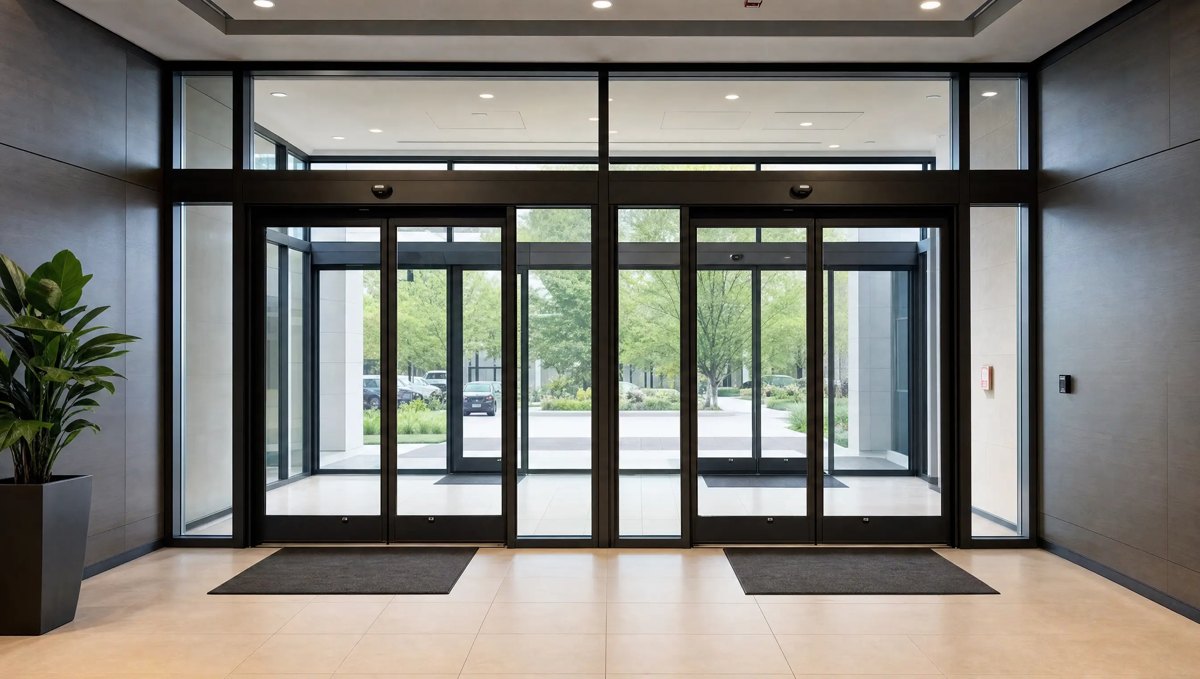
Your automatic entrance is one of the biggest openings in the building, and it swings out to the Arkansas weather hundreds of times a day. In July, that means chilled air pouring out and 95-degree humidity pouring in. In January, it is the reverse. When the door hardware is working the way it should, that exchange is brief and controlled. When it is not, your HVAC system runs longer, works harder, and costs more to keep the lobby comfortable. Here is where automatic doors leak energy, and what actually keeps the gap sealed.
Weather Seals Are the First Line of Defense
Sliding and swinging automatic doors rely on weatherstripping, brush seals, and bottom sweeps to close the gaps around and beneath the panels. These are wear parts. Constant cycling, foot traffic, cart impacts, and Arkansas UV all break them down over time. A brush seal that has gone flat or a sweep that has torn leaves a visible daylight gap, and every gap is a path for conditioned air to escape and outside air to sneak in.
Signs your seals are failing:
- Daylight visible around the door frame or under the panels when closed
- A noticeable draft near the entrance even when the door is shut
- Whistling or air movement you can feel with your hand along the edges
- Condensation or ice buildup near the threshold in cold weather
Replacing worn seals is one of the most cost-effective things you can do for entrance efficiency, and it protects the door hardware from moisture and debris at the same time.
Timing: How Long the Door Stays Open
Every second an automatic door holds open is a second your conditioned air is leaving the building. Door timing controls how long the panels stay open after someone passes through. If that hold-open time is set too long, the door is standing open with no one in the doorway, bleeding energy the whole time. Traffic patterns change, and settings drift over months of use.
Timing, hold-open delay, opening speed, and closing force are safety-critical adjustments governed by AAADM and industry standards. They protect the people walking through the door, so they are not a DIY setting to tinker with. A certified AAADM technician can dial timing to match your actual traffic without compromising the safety sensors or force limits. Tightening up a needlessly long hold-open time is a genuine efficiency win, but it has to be done by someone qualified to keep the door safe.
Vestibules and the Air-Lock Effect
A vestibule, two sets of doors with a small buffer space between them, is one of the best defenses against entrance energy loss. The outer door closes before the inner door fully commits, so outside air never gets a straight shot into the conditioned space. In Arkansas, where summer heat and winter cold both push hard on your HVAC, that air-lock buffer pays for itself in comfort and lower runtime.
If your building already has a vestibule, both sets of automatic doors and their seals need to be maintained for the buffer to work. If you are planning a renovation or a new entrance, a vestibule is worth discussing early. Even without a full vestibule, correct sequencing and reliable closing on your existing doors keeps the opening as short and controlled as possible.
A Door Stuck Open Is a Runaway Bill
The worst-case scenario is an automatic door that fails in the open position. A malfunctioning sensor, a jammed track, a failed operator, or a panel knocked out of alignment can leave your entrance standing wide open. In an Arkansas summer, that is your air conditioning fighting the outdoors all day and losing. It is also a security and safety problem.
A door stuck open is not something to prop shut and ignore, and the operator and sensors are not safe to troubleshoot yourself. This is a call-for-service situation. A certified technician can diagnose whether it is the sensor, the operator, the track, or the controller, and get the door closing correctly again before the energy loss and the exposure add up.
Keep the Gap Sealed
Entrance efficiency is not one fix, it is seals, timing, sequencing, and reliable operation all working together. Regular maintenance catches worn seals and drifting settings before they show up on your utility bill, and keeps your doors safe and code-compliant at the same time.
Frequently asked questions
Can I adjust my automatic door's hold-open time myself to save energy?
No. Hold-open timing, closing force, and speed are safety-critical settings governed by AAADM and industry standards, and adjusting them incorrectly can put people at risk. A certified AAADM technician can safely tighten timing to match your traffic and cut wasted open time.
How often should automatic door weather seals be replaced?
It depends on traffic volume and exposure, but seals are wear parts that flatten, tear, and degrade over time. Have them inspected during regular maintenance visits and replaced whenever you can see daylight, feel a draft, or notice whistling around a closed door.
My automatic door is stuck open. What should I do?
Treat it as a service call, not a DIY fix. A door stuck open drives up heating and cooling costs and creates a security risk, and the operator and sensors are not safe to troubleshoot yourself. Call CSC at 501-548-2374 for a certified diagnosis and repair.