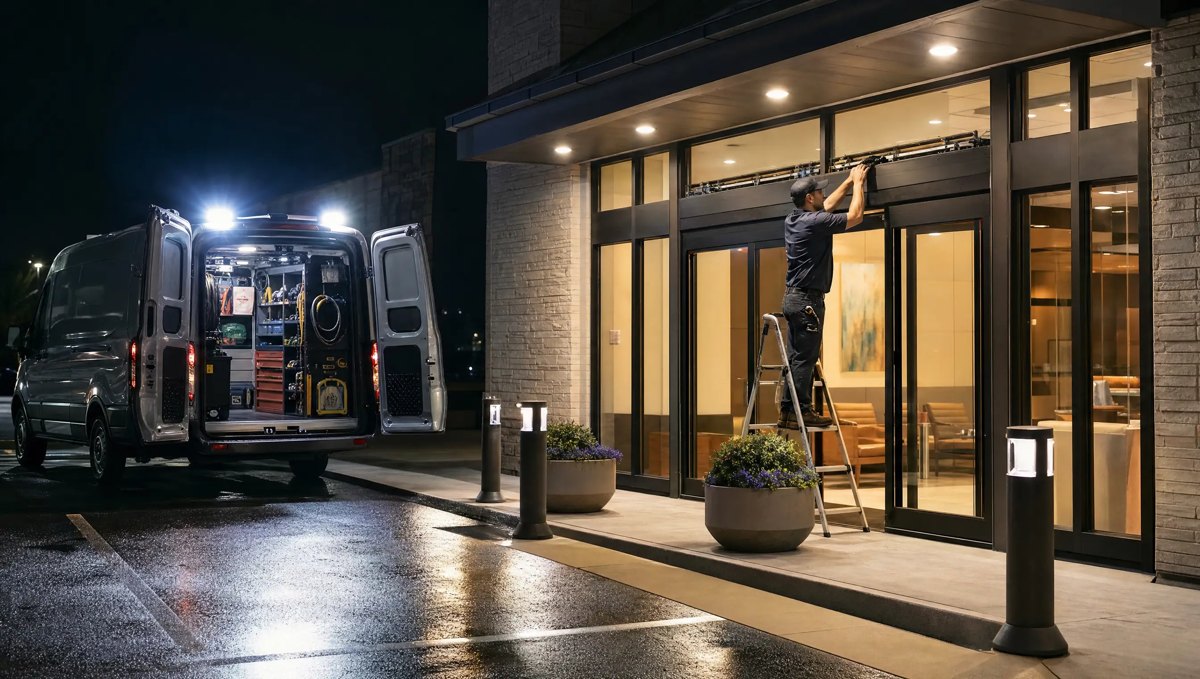
An automatic door is one of the few pieces of equipment in your building that can fail in a way that stops business cold. It either will not let people in, will not keep people out, or has become something people can get hurt on. When that happens at 6 a.m. before a shift change or at 9 p.m. after the last customer leaves, you need to know what to do next. Here is how CSC Automatic Doors handles emergency automatic door repair for central Arkansas businesses, and how you can make that call go faster.
What Actually Counts as an Emergency
A true emergency is any condition where the door has stopped protecting your building or your people. In our experience across retail, healthcare, hospitality, and facility accounts, that usually looks like one of these:
- The door will not secure. It will not close, will not lock, or the lock will not engage, leaving the building open overnight or over a weekend.
- The door is stuck open after hours. Beyond the security exposure, you are heating or cooling the outdoors and the entrance is unattended.
- Broken or cracked glass. A shattered panel is an immediate injury hazard and an open doorway. A cracked panel is a failure waiting to finish.
- The door is striking people or carts. A door closing on traffic, reversing erratically, or swinging without warning is a safety issue that should take the door out of service immediately.
- The door will not open. A jammed entrance can block your accessible route and, depending on the opening, complicate egress — which makes it urgent regardless of the hour.
- The door is your only accessible entrance. If a patient, resident, or customer cannot get in without it, treat it as urgent.
Things that usually are not emergencies: a squeak, a slow-but-safe cycle, a scuffed panel, or a door that works but looks tired. Those belong on a scheduled service visit.
How to Make the Door Safe Until We Arrive
The goal between your call and our truck is simple: keep people away from the failure and do not attempt a repair. Automatic pedestrian doors are governed by strict safety standards for sensing, closing force, and hold-open timing, and those adjustments belong to a certified AAADM-trained technician. Do not open the header, adjust a sensor, re-tension anything, or force a panel back into its track. A well-meaning fix can turn a stuck door into one that closes on somebody.
What you can safely do:
- Take the door out of service. If the operator has an off or manual switch, use it. Otherwise, block the approach on both sides with cones, stanchions, or a cart line so the door stops cycling on traffic.
- Route foot traffic to another entrance and post a clear sign — including an accessible alternate if the failed door was your accessible route.
- If glass is broken, clear people out of the area first, then contain the opening as best you can without touching loose or hanging glass.
- If the building cannot be secured, post someone at the opening or contact your security provider until we get there.
- Leave the fault alone. Do not reset the breaker repeatedly or cycle power over and over — it can bury the error we need to read.
What to Have Ready When You Call
The more we know before we roll, the better the odds we arrive with the right part on the truck. Have this handy:
- Address, entrance location, and the best on-site contact with a phone that gets answered.
- Door type: sliding, swinging, folding, or revolving — and how many panels.
- Brand and model if you can see it, usually on the header cover or inside the operator housing.
- What the door is doing now, in plain terms: stuck open, stuck closed, reversing, drifting, grinding, or dead.
- Any error lights, beeps, or codes showing on the operator or control switch.
- When it started and what changed — a storm, a power event, an impact, a delivery cart, a recent parts change.
- Site access details: after-hours entry, alarm codes handled by your team, gate access, or a badge escort.
What Happens on the Call
We triage by risk. A door that leaves your building unsecured or is contacting people moves to the front of the line. When we arrive, the technician assesses the failure, makes the opening safe, and either completes the repair or secures the door in a safe, controlled state until the part arrives. Before we leave any automatic door in service, it gets tested against the safety standards it is supposed to meet — sensing, force, and timing — not just made to move again.
Commercial Service Company has served central Arkansas businesses since 1976, and our automatic-door division covers Little Rock, Conway, North Little Rock, Benton, Bryant, Maumelle, Jacksonville, Searcy, Russellville, Cabot, Sherwood, and Hot Springs. If your door is down right now, call CSC Automatic Doors at 501-548-2374 and tell us what it is doing — we will take it from there.
Frequently asked questions
What counts as an automatic door emergency?
Any failure that leaves your building unsecured, blocks your entrance or accessible route, involves broken glass, or has the door contacting people or carts. Cosmetic damage, minor noise, or a door that still operates safely can usually wait for a scheduled visit.
Can I keep using an automatic door until a technician arrives?
No. Take it out of service and route traffic elsewhere. A door that is failing in one way may also have compromised sensing, force, or timing that is not visible, so treat it as unsafe until a certified technician has tested it.
Do you handle after-hours automatic door repair in central Arkansas?
Call 501-548-2374 and describe the condition. We prioritize by risk, so doors that will not secure, will not open, or have broken glass move to the front of the line across Little Rock, Conway, Benton, and the surrounding communities.