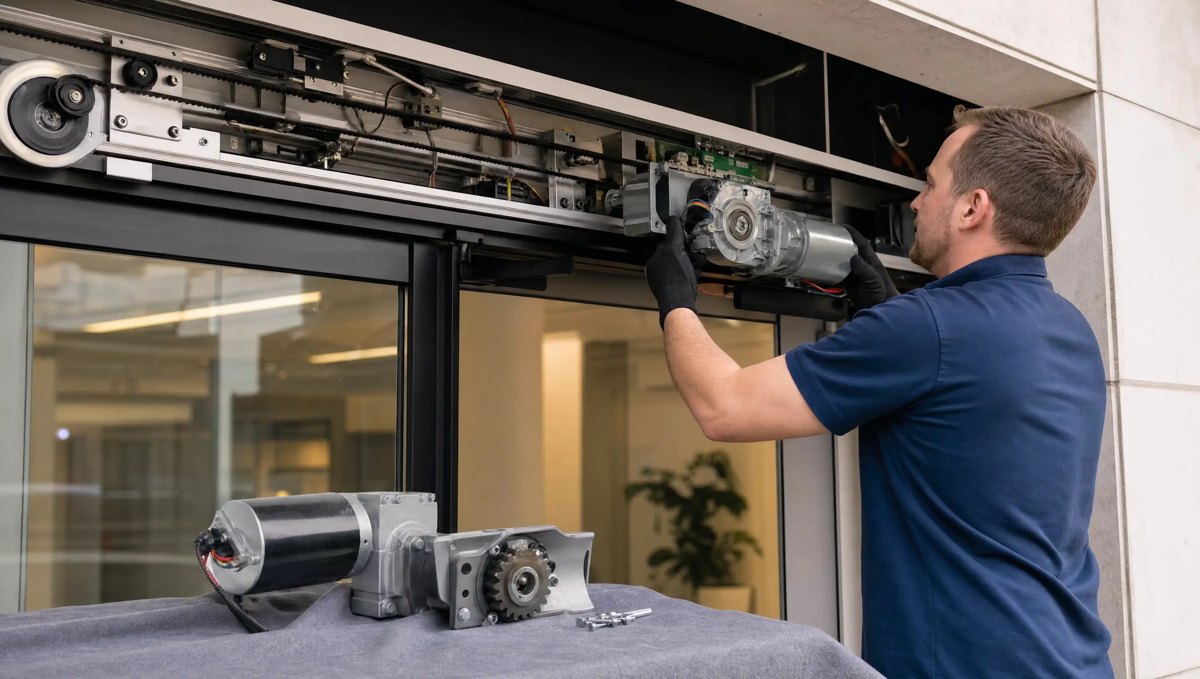
The drive belt is one of the hardest-working parts on a commercial automatic door operator. It transfers motion from the motor to the door panel thousands of times a day at a busy entrance, and like any belt under constant tension and flex, it wears. Catching that wear early keeps a slow slide from turning into a door that won't open for customers, patients, or employees.
Slipping, Jerky Travel, and a Door That Loses Position
A healthy drive belt moves the door smoothly through its full open and close cycle at a consistent speed. When a belt starts to slip on its pulley or has stretched beyond its working tension, you'll notice:
- A jerky or hesitant motion instead of a smooth glide, especially at the start or end of travel
- The door slowing down, stalling partway, or seeming to "fight" itself mid-cycle
- A door that stops in the wrong spot, doesn't fully seat when closed, or doesn't reach full open
- A grinding, slapping, or squealing noise from inside the header as the belt moves
That last symptom — a door losing position — matters more than it might seem. An automatic door that can't reliably find its open or closed position can leave a gap at an entrance, fail to close and secure the opening, or stop in a spot that's awkward or unsafe for people passing through. Any of these signs is a reason to get the door looked at rather than wait for it to fail completely.
Belt Stretch and Pulley Wear in High-Cycle Entrances
Not every entrance sees the same wear. A door at a busy retail storefront, hospital entrance, or restaurant that cycles hundreds of times a day puts far more load on its drive belt than a low-traffic side entrance. In these high-cycle locations, belt stretch happens faster, and it rarely shows up alone — the pulleys and idlers the belt rides on wear right along with it.
- A stretched belt rides differently on the pulley, which accelerates wear on the pulley grooves and bearings
- Worn pulleys, in turn, cause the belt to track unevenly, which speeds up belt wear
- Once this cycle starts, tension adjustments alone stop being a lasting fix, and the belt or pulley hardware needs replacing
Facilities with high-traffic automatic doors benefit from routine, scheduled checks rather than waiting for a visible problem, since the wear on these components tends to compound quickly once it starts.
Why Belt Tension Is Set With the Operator Powered Down by a Trained Tech
It might seem simple to snug up a loose-looking belt, but drive belt tension on a commercial automatic door operator is a safety-critical setting. Too much tension stresses the motor and shortens component life. Too little, and the belt slips under load, which can cause the door to behave unpredictably as people are walking through it.
Because the operator stores mechanical energy and connects to moving door panels, tension work is done with the unit fully powered down, following the manufacturer's specified procedure and limits. A certified AAADM technician also verifies force and travel settings afterward, using proper testing equipment, since a tension change can shift how the door performs across its whole cycle. This isn't a job for guesswork or a quick fix between customers — it's a job for someone trained on that specific operator.
What Facility Owners Can Do
You don't need to diagnose the exact cause to know when something's off. Watch for the signs above, and treat a jerky, slow, or position-losing automatic door as a signal to schedule service rather than something to monitor indefinitely. Left alone, a worn belt tends to fail at an inconvenient time — often during your busiest hours.
- Note when the unusual motion or noise started and whether it's getting worse
- Avoid propping, forcing, or manually cycling a door that's already struggling
- Flag the entrance for inspection rather than waiting for a full stoppage
CSC Automatic Doors has served central Arkansas businesses since 1976, working on commercial entrances across Little Rock, Conway, North Little Rock, Benton, Bryant, Maumelle, Jacksonville, Searcy, Russellville, Cabot, Sherwood, and Hot Springs. If your automatic door is slipping, jerky, or losing position, call 501-548-2374 and our AAADM-certified technicians will get it inspected and running smoothly again.
Frequently asked questions
How do I know if it's the drive belt and not something else causing my door to act up?
Jerky motion, slowing mid-cycle, or a door that stops in the wrong position are common belt symptoms, but similar behavior can come from sensors, the control board, or the operator itself. A trained technician can pinpoint the actual cause during an inspection.
Can I tighten the drive belt myself if it looks loose?
No. Belt tension is a safety-critical setting tied to the manufacturer's specified procedure, and it's adjusted with the operator powered down by a certified AAADM technician using proper testing equipment. Incorrect tension can affect how the door performs when people are walking through it.
How often should high-traffic automatic doors be checked for belt wear?
Entrances that cycle heavily, like busy retail or healthcare entrances, benefit from routine scheduled checks rather than waiting for visible problems, since belt and pulley wear tend to accelerate once they start.