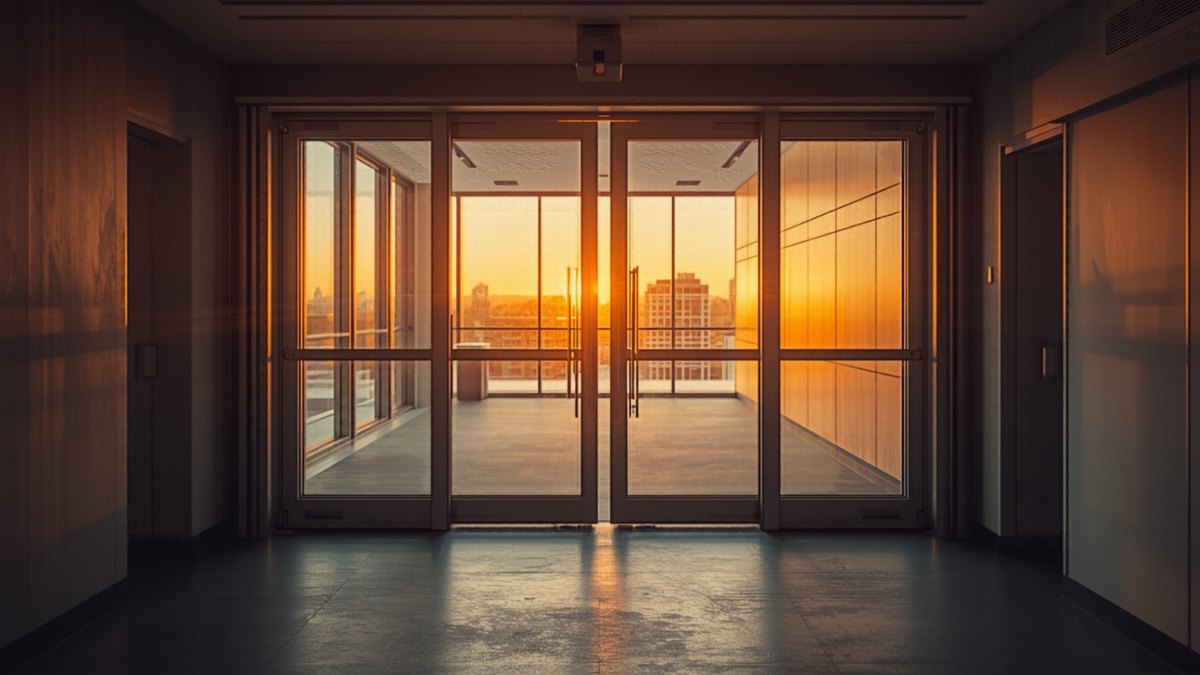
Central Arkansas loses power. Ice takes a line down in January, a storm knocks out a block in Conway, a transformer goes on a Saturday in Little Rock. Most of your building handles it fine. Your entrance is the exception: an automatic door is a powered machine standing in the one path everybody uses to get in and, more importantly, to get out.
What Happens the Moment the Power Drops
Most owners have never watched their own doors lose power with the building full. What happens depends on how the operator was set up at installation — worth knowing in advance rather than during a storm.
A sliding door stops being automatic. The motor has no power, the overhead sensors have no power, and the panels stop responding to anyone walking up. Depending on the configuration, the panels may sit wherever they were when the power cut, may be held by an electric lock, or may be free enough to push by hand. A slider that was closed and locked stays closed and locked.
A swing operator behaves differently. Without power the operator is no longer pushing the door open, so it becomes a manual door — usually a heavy one. The same closer and gearing that give you a smooth automatic swing add real resistance when someone has to move the leaf. Staff can normally manage it. An elderly customer with a cart, a parent carrying a child, or someone using a walker often cannot.
Break-Out: How a Slider Lets People Out
Most commercial sliding entrances are built with break-out panels. Push firmly on the panel in the direction of travel out of the building and it swings outward on a pivot, creating an open path with no power and no motor to help. It is the escape hatch built into the door, and it works with the electricity off.
Break-out only works if nothing is in its way. What defeats it is ordinary and preventable:
- Seasonal displays, floor mats, sandwich boards, or carts staged in the swing path
- Snow, ice, or debris piled against the outside of the panels
- A pivot that has been dragging for months and nobody reported it
- Staff who have never been shown that the panel breaks out at all
That last one matters. In a real emergency with the lights off, nobody reads a sign. Show your team where the break-out panels are and how they open, the same way you show them where the extinguisher is.
Getting People Out Is the Part That Cannot Fail
Everything else about an outage is an inconvenience. The register is down, the cooler is warming, the phones are out. An entrance that traps people is a different category of problem, and the one thing about your doors with no acceptable workaround. Whatever your entrance does when the power drops, people inside must still be able to leave without special knowledge, a key, or unusual strength. If you cannot say what your doors do in an outage, have that answered on the next service visit.
Battery Backup Options
Battery backup for an automatic door is not one product. The right choice depends on what you need the door to do when the power is gone. The options fall into a few buckets:
- Fail-safe positioning — a backup module carries just enough power to drive the door to a chosen position, open or closed, then stops. Common where a defined resting state matters.
- Continued operation — a larger battery keeps the operator and its sensors running for a limited time, so the door keeps cycling while the building is on generator or waiting on the utility.
- Locking and access power — electric locks, card readers, and hold-open devices tied into the entrance have their own power needs, and how they behave without power is a design decision, not an accident.
Two things are true of all of them. Batteries are consumables; they age quietly and are often dead long before anyone notices, because nothing looks wrong until the day it is needed. And the sizing, wiring, and settings are technician work — not a job for a maintenance staffer or an electrician unfamiliar with door hardware. It belongs to a certified automatic door technician who can verify the door still opens, closes, and senses correctly afterward.
After the Power Comes Back
Doors do not always return to normal on their own. Watch for a slider that will not re-home or hunts back and forth, a door running faster or slower than it did, an operator that stays dead after the breaker is reset, or a break-out panel that is not sitting square in the track. Any of those means the door needs a technician before it goes back into public use.
If you are not sure how your entrances behave in an outage, or you want battery backup priced for a building in Conway, Little Rock, Benton, Searcy, or anywhere in central Arkansas, call CSC Automatic Doors at 501-548-2374. We have kept commercial doors working here since 1976, and we would rather answer the question now than during the next storm.
Frequently asked questions
Will my automatic door open by itself if the power goes out?
Not on its own, unless it has a battery backup set up to drive it to a chosen position. Without power the operator stops, and how the panels sit depends on the door's configuration and any electric locks tied to it.
How do people get out of a sliding automatic door during an outage?
Most commercial sliders have break-out panels that swing outward when pushed firmly, opening a clear path with no power at all. Keep that swing path free of displays, mats, and carts, and make sure staff know the panels break out.
How long does automatic door battery backup last?
It depends on the module, the door, and what it is powering, so any number quoted without seeing your equipment is a guess. Batteries also lose capacity as they age, which is why backup should be tested on a regular service schedule.