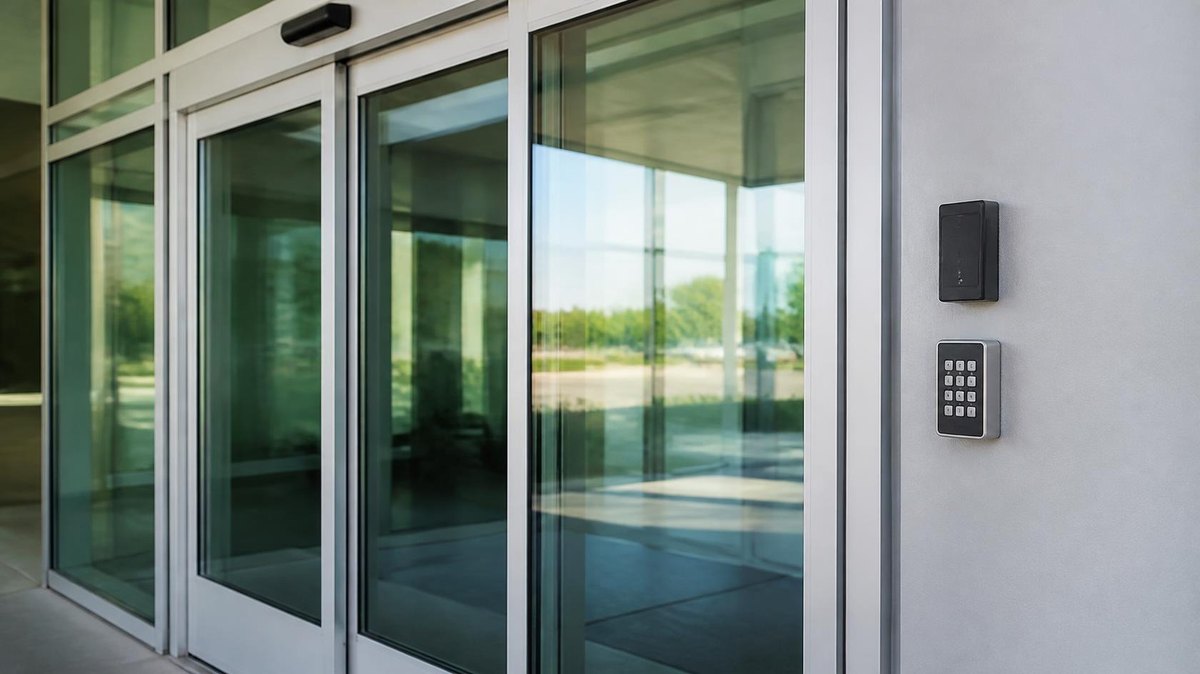
What integration actually means on an existing door
Most buildings already own both halves of the job. There is an automatic operator — a swing arm overhead or a sliding package in the header — and somewhere there is a lock, a badge system, or a keypad that got added later. Automatic door access control integration is the wiring and logic that makes those two systems agree on one thing: who gets in, when, and in what order the door unlocks and then opens.
Order matters. An operator that tries to move before the lock releases will bind against the latch, and a few hundred cycles of that buys you an arm, a belt, or a motor. Done right, the credential releases the lock first, the operator gets its signal a moment later, and the door cycles with no strain.
The hardware that usually goes on the door
- Proximity card and fob readers wired back to an access panel you already own.
- Standalone keypads for a single door where there is no panel and no software.
- Mobile credentials, where staff badge in from a phone.
- Interior and exterior actuators — push plates or wave switches — that request the open cycle once access is granted.
A push plate is not access control. It is a request to open. Keeping those two roles separate makes the rest of this straightforward.
Wiring and relay basics
Almost every access system talks to an operator through a dry contact — a relay that closes a circuit and says go. The operator does not care whether a card reader, a keypad, an intercom, or a schedule in software closed it. That is what makes retrofits practical on doors ten and fifteen years old.
A typical integrated entry carries two low-voltage runs: an activation pair from the access system to the operator input, and a lock circuit fed from a power supply sized for the lock. Electrified latch retraction pulls a heavy inrush the instant it fires, so it needs a supply built for it — undersized power is a common reason a retrofit tests fine and then stutters on the building. Control wiring stays out of line-voltage conduit, and the operator needs a circuit nobody switches off at night.
Whether the lock holds or releases when power drops is not a preference. It depends on the role that opening plays in getting people out of the building, and it gets settled with your door contractor and the local authority before anything is ordered.
After-hours schedules and door modes
This is the part facility managers actually want. A scheduled entry runs unlocked and fully automatic during business hours, drops to badge-only at close, and sits locked overnight. Cleaning crews, delivery windows, early clinic staff, and holiday calendars all live in that same schedule.
Modes are worth knowing, because most operators have a mode switch: off, hold open, automatic, and one-way or exit-only. A surprising share of the calls that come in as the door is broken turn out to be a door left in the wrong mode or a schedule that never rolled over. Before assuming the operator failed, check what mode it is in and what the schedule says it should be doing.
Locking it down without losing the accessible entry
Here is the failure we get called out to fix. Somebody locks the main entrance after hours, and now an employee with a valid badge has to haul open a heavy manual door because the operator stopped answering. That lockdown quietly removed the accessible entrance.
Doing it right means the operator still runs for anyone with a credential, at every hour the building is occupied:
- A valid card, code, or fob releases the lock and triggers the open cycle — one action, no pulling.
- Readers and keypads are mounted where they can be reached from a seated position and clear of the door swing.
- Exterior actuators stay live for credentialed users after hours instead of going dead with the lock.
- Getting out is never harder than getting in.
What we look at before quoting
- Operator make, model, and age, and whether the board has the inputs the job needs.
- The access panel or software you already run, so we integrate with it instead of replacing it.
- Door type — swing, slide, or telescopic — and the lock hardware on it now.
- Available power at the header and the condition of the existing sensors.
- Traffic and hours, which drive both the schedule and the wear to plan for.
Why this is not a handyman job
Adding a relay is the easy half. Once activation or locking changes, the door has to be re-verified: opening and closing force, hold-open time, sensor coverage on both sides, and how it behaves when someone stops in the opening. That belongs to an AAADM-certified technician, the same day the wiring changes — not at the next annual inspection.
CSC Automatic Doors has served central Arkansas businesses since 1976, from Conway and Little Rock to Benton, Bryant, Searcy, Cabot, and Hot Springs. If you want card readers, keypads, or after-hours schedules tied into the doors you already have, call us at 501-548-2374 and we will look at the opening and tell you plainly what it takes.
Frequently asked questions
Can card readers be added to an automatic door we already have?
Usually, yes. Most commercial operators accept a dry-contact activation input, so a card reader, keypad, or intercom can trigger the door without replacing the operator. What decides it is the age and condition of the control board, the lock hardware on the door, and whether power is available at the header. A site visit answers all three in a few minutes.
Will locking the entrance after hours hurt our accessible entry?
It will if the lockdown kills the operator along with the lock. Done properly, a valid credential releases the lock and starts the open cycle in one action, so a badge holder using a wheelchair gets the same hands-free entry at 9 p.m. as at 9 a.m. Readers and keypads also have to be mounted within reach and clear of the door swing.
Our door will not open in the morning. Is the operator broken?
Not always. On a scheduled entry, the two most common causes are a mode switch left in the wrong position and a schedule or holiday calendar that never rolled over. Check the mode and the schedule first. If both are correct and the door still will not cycle, stop there and have a certified technician look at it rather than adjusting anything yourself.