For any business open to the public, the front door is more than a way in — it's a legal and practical commitment to serving every customer who walks, rolls, or is carried through it. Automatic doors are one of the most reliable ways to meet accessibility expectations, but installing an operator alone doesn't guarantee your entrance is compliant. Here's what facility managers, retail owners, and healthcare and hospitality operators across central Arkansas should understand about accessible automatic doors.
What Accessibility Actually Means at the Door
Accessibility comes down to how people with disabilities access buildings that serve the public. At an entrance, that touches several things working together: a clear, level approach with enough room to maneuver, hardware that doesn't require tight grasping or twisting, doors that open easily, and doors that stay open long enough for someone using a wheelchair, walker, or cane to pass safely.
Automatic doors solve many of these challenges at once. When someone doesn't have to pull a heavy door against a closer, the opening force problem disappears. When the door stays open on a timed cycle, the person crossing the threshold isn't rushed. But those benefits only hold when the operator is set up and maintained to the correct standards — which is why the equipment is only part of the picture.
Push-Plate Actuators and How They Help
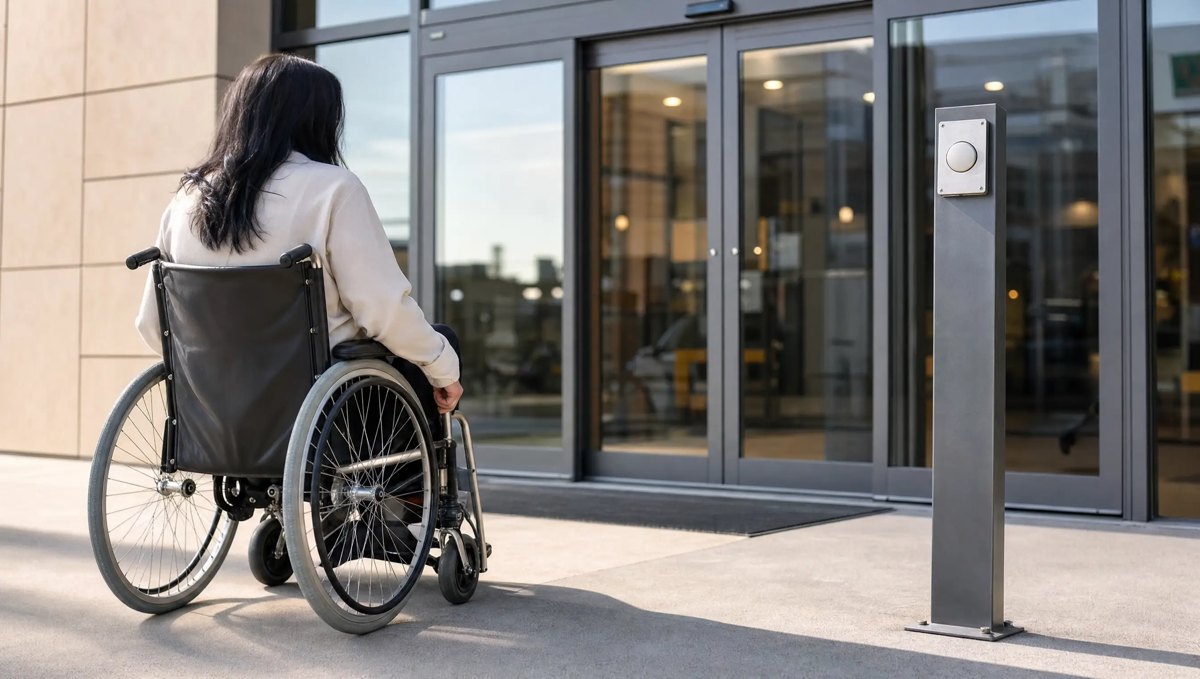
A push-plate actuator is the wall- or bollard-mounted button — often marked with the blue wheelchair symbol — that a customer presses to trigger the door. It's one of the simplest and most recognizable accessibility features, and it matters for a few reasons:
- It gives people who can't approach a swinging door safely a reliable, hands-light way to open it.
- It provides a consistent activation method when motion or approach sensors alone aren't ideal for the space.
- Its mounting height and location affect whether someone in a wheelchair can actually reach and use it.
Placement is easy to get wrong. An actuator mounted too high, tucked behind a railing, or positioned where the opening door would strike the person pressing it defeats its purpose. Correct location and wiring should be handled by a qualified technician who understands both the standards and how the door will move.
Why Compliance Matters: Liability and Reputation
Accessibility isn't only the right thing to do — it carries real exposure. Businesses that fail to provide compliant access can face complaints, demand letters, and legal action. Beyond the legal risk, an entrance that traps or excludes a customer damages your reputation in a way that's hard to undo, especially in tight-knit Arkansas communities where word travels.
There's a safety dimension too. An automatic door with an operator pushing too hard, closing too fast, or with a failed sensor can strike or trip a customer. That's both an accessibility failure and an injury risk. The goal is an entrance that opens smoothly, closes safely, and works the same way every time — for a parent with a stroller, a delivery driver with a hand truck, or a patient leaving a clinic.
The Role of Regular Inspection
Automatic doors are machines in constant use, and their settings drift over time. Force, opening and closing speed, hold-open time, and sensor performance can all fall out of specification through normal wear. That's why routine inspection by a certified technician is central to staying compliant.
A proper inspection verifies that the door opens and closes within safe force and timing ranges, that sensors detect people in the path reliably, that the push-plate activates correctly, and that safety features stop or reverse the door as designed. These checks follow recognized industry standards, and the adjustments involved are safety-critical.
This is not DIY territory. Adjusting operator force, timing, electrical components, or sensors on an automatic door should always be left to a certified AAADM technician. Guessing at these settings can create the exact hazards compliance is meant to prevent.
Keeping Your Entrance Accessible Year-Round
Compliance isn't a one-time box to check at installation — it's an ongoing standard your entrance has to hold every day it's open. Regular professional service keeps your automatic doors accessible, safe, and dependable, so accessibility is never something a customer has to think about.
If you operate a facility, store, clinic, or hospitality space in Little Rock, Conway, Benton, or anywhere across central Arkansas and want your automatic doors inspected or serviced, CSC Automatic Doors has served the region since 1976. Call us at 501-548-2374 to schedule a visit or talk through your accessibility needs.
Frequently asked questions
Do I need an automatic door for an accessible entrance?
An automatic door is not the only way to make an entrance accessible, but it is the most reliable one. What matters is an entrance with manageable opening force, adequate clearance, and hardware that's usable without tight grasping. Automatic doors are one of the most effective ways to meet those requirements, which is why so many businesses choose them. If you are unsure where your entrance stands, we can come look at it.
Can I adjust my automatic door's speed or force myself?
No. Opening force, speed, hold-open timing, sensors, and electrical components are safety-critical and must be set to recognized standards. Incorrect settings can injure customers and create liability. Always have these adjustments made by a certified AAADM technician rather than attempting them yourself.
How often should accessible automatic doors be inspected?
Automatic doors see heavy daily use, and their settings drift over time, so regular professional inspection is important to keep them safe and compliant. A certified technician can verify force, timing, sensor performance, and push-plate function. Call CSC at 501-548-2374 to set up a service schedule that fits your facility.